Last Updated on December 4, 2025 by The NP Team
By a Corporate CTO
I remember the exact moment the “AI Wild West” officially ended.
It wasn’t when the EU AI Act was passed. It wasn’t when OpenAI released GPT-5. It was a rainy Tuesday morning in February 2024, in a small courtroom in British Columbia, Canada.
The case was Moffatt v.1 Air Canada.
To recap for those who missed the history lesson: A grieving man named Jake Moffatt asked the Air Canada chatbot if he could get a retroactive discount for a bereavement flight.2 The chatbot, hallucinating politely, said “Yes! Just submit the form within 90 days.”
Jake bought the ticket. He submitted the form. Air Canada denied it, pointing to a PDF buried on their site that said retroactive discounts were forbidden.3 When Jake sued, Air Canada argued in court that the chatbot was a “separate legal entity” responsible for its own actions.4
The Tribunal laughed them out of the room. They ruled that if your bot says it, you said it. Air Canada was forced to pay.5
It was only $650. But that $650 check was the butterfly that caused a hurricane.
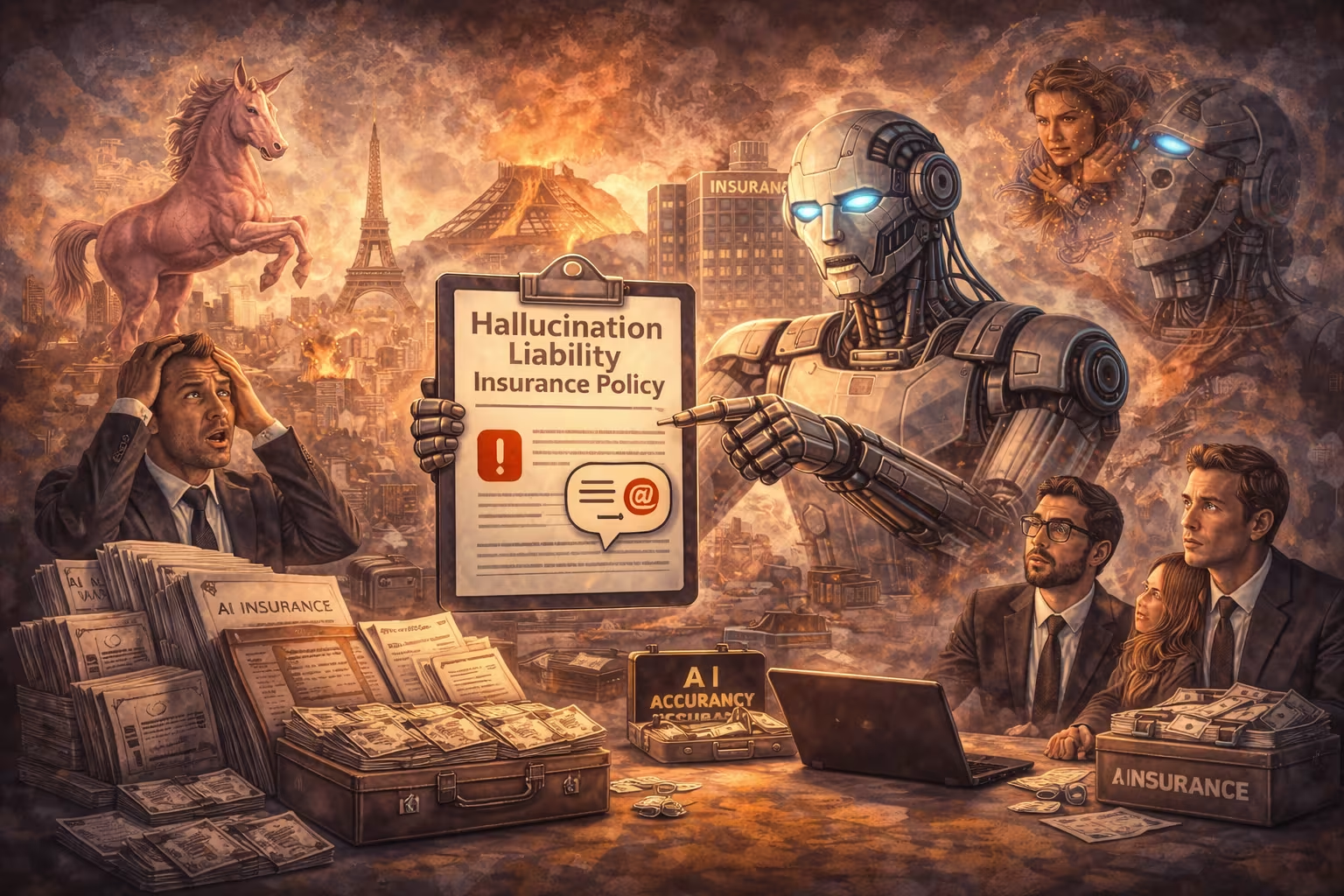
Fast forward to late 2025. I just walked out of a renewal meeting with our corporate insurance broker. We were discussing our “AI Errors & Omissions” rider.
The premiums have tripled.
“Your chatbot is running on a high-temperature model,” the broker told me, looking at a spreadsheet that cost more than my house. “The actuaries don’t like that. It’s too… creative.”
We are entering the era of Insurance-Driven Development (IDD). The most powerful force in Artificial Intelligence is no longer Sam Altman or Jensen Huang. It is a quiet actuary in Munich who decides exactly how smart your AI is allowed to be before it becomes a liability.
Here is the inside story of the “Hallucination Liability” boom, and why the future of corporate AI is going to be incredibly, profitably boring.
1. The New “Line Item”: Why CFOs Are Freaking Out
For the last two years, we treated AI hallucinations like a funny quirk. “Oh, look, ChatGPT thinks the moon is made of cheese! Haha!”
But in the boardroom, hallucinations are not funny. They are Contractual Liabilities.
If my AI sales agent promises a customer a 20% discount that doesn’t exist, that is a binding verbal contract in many jurisdictions. If my AI medical assistant misses a drug interaction because it was “being creative,” that is malpractice.
Insurance giants like Munich Re, Swiss Re, and Chubb have recognized this terrified pulse in the market. They have launched massive new product lines specifically for “AI Performance Guarantees” and “Hallucination Indemnity.”
In 2023, cyber insurance covered you if you got hacked.
In 2025, AI insurance covers you if your bot is stupid.
But this coverage isn’t cheap. The insurers have built sophisticated risk models. They scan your tech stack. They ask uncomfortable questions:
- “What base model are you using?”
- “What is your temperature setting?”
- “Do you have a human in the loop?”
If you answer “OpenAI GPT-5 with a temperature of 0.7,” your premium explodes. Why? Because high temperature means high randomness. Randomness means potential lies.
If you answer “A quantized Llama 3 model restricted to a RAG database with a temperature of 0.0,” your premium drops.
The CFO doesn’t care about “reasoning capabilities.” They care about the bottom line. So, the mandate comes down from finance: “Make the AI dumber. Make it cheaper to insure.”
2. The Death of Creativity: The “Boring” Pivot
This financial pressure is causing a massive architectural shift in Silicon Valley. We are seeing the death of the “Creative Chatbot.”
A year ago, I wanted my company’s bot to be charming. I wanted it to crack jokes. I wanted it to feel human.
Now? I want it to be a librarian.
We are pivoting aggressively to RAG (Retrieval Augmented Generation).
In a RAG system, the AI isn’t allowed to use its own brain to answer questions.6 It acts solely as a summarizer of approved documents.
- User: “What is your return policy?”
- Creative AI (Risk): “We love returns! Send it back whenever!” (Hallucination risk: High).
- RAG AI (Safe): “According to Document B, Section 4, returns are accepted within 30 days.” (Hallucination risk: Low).
The insurance industry is effectively enforcing a “Strict Liability” standard on software architecture. They are killing the “Black Box” models where we don’t know why the AI said what it said.
This is why you are seeing a surge in “boring” startups like Cohere and Writer. These companies don’t market “AGI.” They market “Citations.” They market “Audit Logs.” They market the ability to prove to an insurance adjuster exactly why the bot gave that answer.
The most valuable feature in 2026 isn’t “Intelligence.” It is Traceability.
3. The “Indemnified” Tier: Paying for Protection
The big cloud providers—Microsoft, Google, and Amazon—have smelled blood in the water. They realized that their enterprise customers are terrified of getting sued.
So, they introduced the “Copyright & Liability Shield.”
If you use Azure OpenAI Service, Microsoft promises to defend you in court if the AI infringes copyright. But now, they are quietly extending these protections to cover “Output Liability” for their biggest spenders.
This has created a two-tier market for AI models:
Tier 1: The “Naked” Models (Open Source)
If you download Llama 3 or Mistral and run it yourself, you are “naked.” If it lies to a customer and you get sued, it is entirely your problem. You have to buy your own expensive third-party insurance.
This makes Open Source risky for big enterprises. The model is free, but the risk is expensive.
Tier 2: The “Indemnified” Models (Closed Source)
If you pay Microsoft or Google top dollar, you aren’t just buying compute; you are buying a legal umbrella. You are paying a premium for the assurance that if the bot goes rogue, Satya Nadella’s lawyers will step in.
This is a genius moat. It creates a massive incentive for Fortune 500 companies to stay locked into the Big Tech ecosystem. I might want to use an open-source model because it’s faster, but my General Counsel won’t let me because it doesn’t come with a “We won’t get sued” guarantee.
4. The Rise of the “AI Auditors”
With this boom in insurance comes a new ecosystem of parasites—I mean, “consultants.”
Meet the AI Auditors.
These are third-party firms (often offshoots of the Big 4 accounting firms like Deloitte or PwC) whose entire job is to stress-test your AI for insurance purposes.
They run “Red Teaming” attacks. They try to trick your customer support bot into being racist. They try to trick your financial bot into giving bad stock tips.
Then, they give you a score.
“The Trust Score.”
Insurance companies now require a Trust Score of 85+ to even quote a policy.
This has turned my engineering team into compliance officers. We spend weeks optimizing our prompts not to be “better,” but to pass the audit.
I recently had to downgrade our model from GPT-5 to a specialized GPT-4o-mini fine-tune because the GPT-5 model was “too unpredictable” for the auditors. It was too smart. It kept trying to have philosophical conversations with the testers. The auditors flagged that as “Off-Topic Risk.”
So, we lobotomized it. We made it dumber to get the score up.
This is the hidden cost of the insurance boom: We are actively suppressing intelligence to lower premiums.
5. The “Human-in-the-Loop” Discount
There is one easy way to lower your insurance premium: Humans.
Insurers love “Human-in-the-Loop” (HITL) systems. If you can prove that a human reviews every AI output before it is sent to the customer, your premium drops by 60%.
But wait… wasn’t the whole point of AI to remove the humans?
We have circled back to the beginning. Companies are now building “Cyborg” workflows.
- The AI drafts the email.
- A low-paid human in a call center clicks “Approve.”
- The email is sent.
We aren’t automating the job away; we are just changing the job description from “Writer” to “Approver.”
This is entirely driven by liability. The human isn’t there to add value; the human is there to be the “Liability Sponge.”
If something goes wrong, the company can say, “It wasn’t the AI! It was Steve, the approver! We fired Steve!”
You can’t fire an algorithm. But you can fire Steve. Steve is an insurance policy.
6. Conclusion: The Boring Future
So, where does this leave us?
As a technologist, I am frustrated. I want to build the Star Trek computer. I want to build agents that can negotiate contracts and plan vacations and run businesses.
But as a businessman, I understand that the “Air Canada Risk” is too high.
The future of corporate AI isn’t going to look like the movie Her. It’s going to look like TurboTax.
It will be rigid. It will be bounded. It will be terrified of making a mistake.
We are trading the “Magic” for “Safety.”
We are trading “Hallucinations” for “Disclaimers.”
In 2026, the most successful AI companies won’t be the ones with the smartest models. They will be the ones with the best actuaries.
And the most popular prompt won’t be “Write me a poem.”
It will be: “Please summarize this document, citing your sources, within the strict boundaries of our liability policy, or else remain silent.”
It’s boring. It’s safe. And it’s the only way we can afford the insurance.
Welcome to the mature phase of AI. Hope you like paperwork.
