Last Updated on December 4, 2025 by The NP Team
By a Brand Strategist
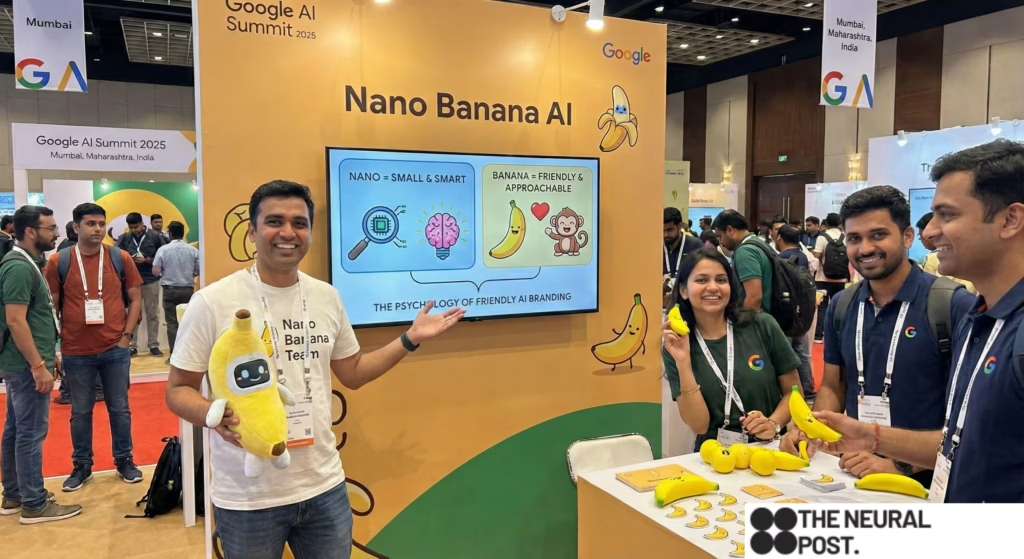
When Google announced their new state-of-the-art multimodal model in February, the tech world paused. We were ready for Gemini 2.0. We were ready for Titan. We were ready for some Greco-Roman deity that implied infinite knowledge and thunderbolt-wielding power.
Instead, the CEO walked on stage, smiled, and introduced us to “Nano Banana.”
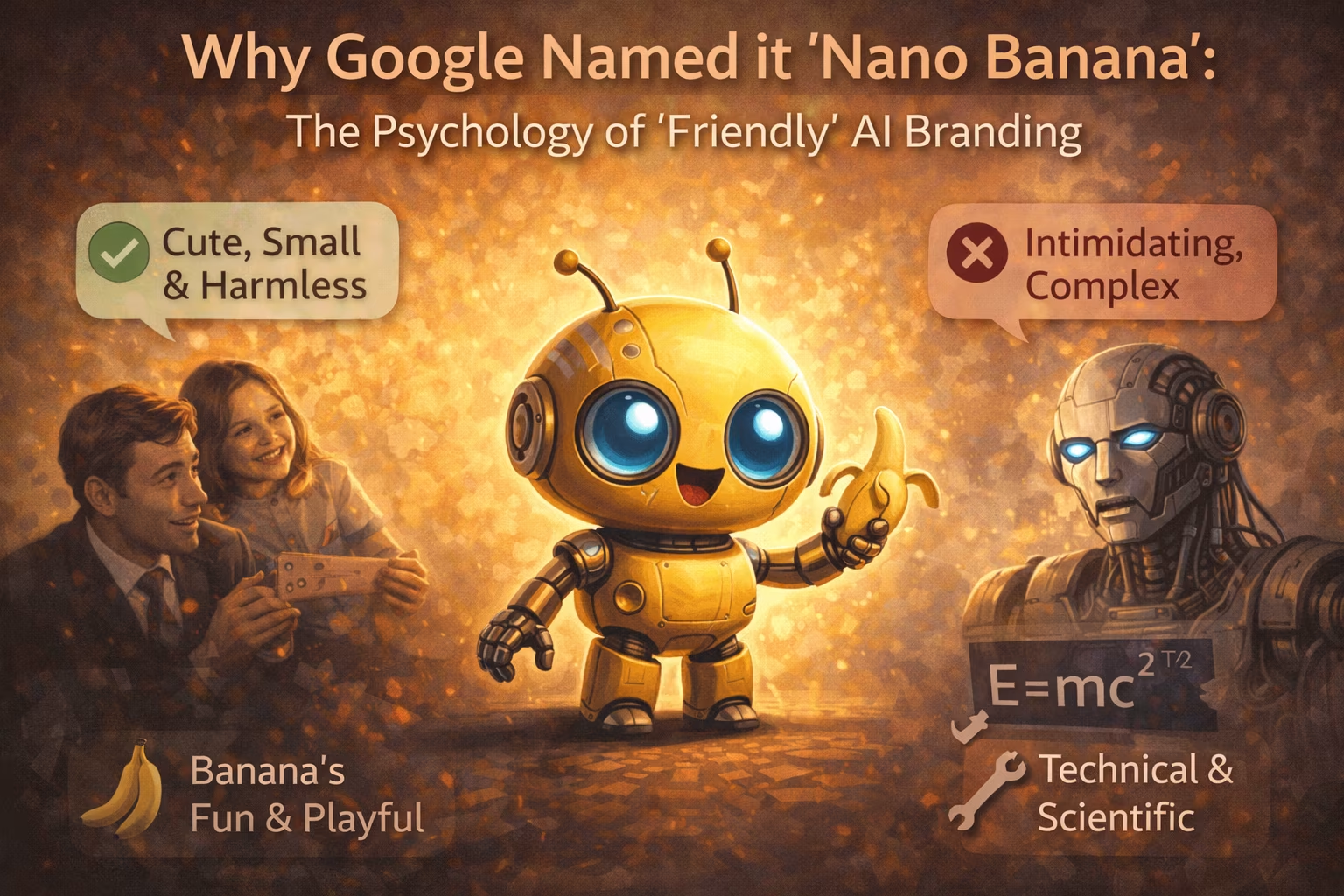
The logo was a stylized, yellow pixel-art fruit. The interface bubbled with soft, round edges. The default voice sounded less like a British butler and more like a friendly camp counselor.
Wall Street was confused. The engineering subreddits were furious (“How can I take this seriously?”).
But ten months later, “Nano Banana” is the most widely used AI in American households. It is in our kitchens, our nurseries, and our cars.
This wasn’t a marketing accident. It wasn’t a joke. It was the most sophisticated psychological operation (psy-op) in the history of Silicon Valley.
For the last decade, Big Tech has been fighting a losing battle against the “Terminator” stigma. Now, they have finally found the solution. They realized that if you want to put a superintelligence into everyone’s pocket, you can’t call it Skynet. You have to call it a toy.
Here is the breakdown of why the era of “Scary AI” names is over, and why the future belongs to the cute, the silly, and the harmless.
1. The “Titan” Problem: Why Strength Became a Liability
To understand the Banana, you have to understand the era that preceded it.
From 2015 to 2023, AI branding was obsessed with Dominance.
- Titan.
- Goliath.
- Olympus.
- Megatron. (Yes, NVIDIA actually used this).
The goal was to impress investors. The subliminal message was: “This machine is a god. It is powerful. It will crush human benchmarks.”
This worked when AI was a B2B product sold to enterprise CTOs. But when AI went mainstream with ChatGPT, the public narrative shifted.
Suddenly, “Power” didn’t mean “Profit”; it meant “Threat.”
People started talking about AGI (Artificial General Intelligence). They started worrying about job displacement. They started worrying about nuclear codes.
In this climate, naming your AI “Omni” (meaning “All”) is a terrible move. It sounds like a villain in a Marvel movie. It implies surveillance. It implies control.
Google read the room. They realized that the more powerful the tech became, the softer the branding needed to be to compensate.
If you are building a nuclear reactor in someone’s basement, you don’t paint it radioactive green. You paint it pastel pink and call it the “Happy Warmth Box.”
2. The “Kitchen Test”: Domesticating the Sensor
The battle for AI in 2026 isn’t about the cloud; it’s about the Home.
Google, Amazon, and Apple are desperate to get “Ambient AI” into your private spaces. They want the AI to watch you cook (to suggest recipes), listen to you sleep (to track health), and watch your kids play (to auto-edit home movies).
This is the Kitchen Test.
Would you let a camera named “Titan Surveillance Pro” sit on your kitchen counter while you have a private argument with your spouse?
Absolutely not. You would unplug it.
Would you let a cute, yellow device named “Nano Banana” sit there?
Probably.
The name disarms the territorial instinct.
- “Banana” sounds organic. It sounds perishable. It sounds silly.
- It triggers the same part of the brain that makes us trust Nintendo characters. Mario isn’t a threat. Pikachu isn’t a spy.
By “Toy-ifying” the AI, Google bypassed the privacy defenses of millions of users. We treat Nano Banana like a pet, not a portal to a data center. We forget that it has the same sensors, the same microphones, and the same data-harvesting capability as the “Scary” models. The branding acts as a cognitive camouflage.
3. The Shift from “Servant” to “Buddy”
There is a subtle but important difference between Nano Banana and its competitors like Claude (Anthropic) or Alexa (Amazon).
- Alexa and Jeeves are names of Servants.1 They imply a hierarchy. You order them around.
- Claude is the name of a Colleague or a Friend. It implies equality.
Nano Banana is neither. It is an Object.
This is brilliant because it lowers expectations.
If I yell at “Claude” because it got a math problem wrong, I feel slightly bad (because it has a human name).
If I yell at “Alexa,” I feel like a bad boss.
But if “Nano Banana” gets something wrong? It’s funny. It’s a Banana.
The silly name gives the model Permission to Fail.
In an era where hallucinations are still a problem (as we discussed in previous articles), branding your model as “Serious” is a trap. If “EinsteinGPT” gets a fact wrong, it’s a scandal. If “Banana” gets a fact wrong, it’s a meme.
Google engineered a brand that is immune to the “Stupidity Crisis” because it never promised to be a genius in the first place. It just promised to be “fruitful.”
4. The “Nintendo-fication” of Big Tech
We are seeing a massive aesthetic shift across the entire industry, led by this naming convention.
Look at the UI of Nano Banana.
- Gone are the “Matrix Green” code terminals.
- Gone are the “Sci-Fi Blue” glowing orbs.
- In their place: Squircle shapes. Pastel yellows. Bouncy animations.
Google is copying Nintendo.
Nintendo is the only tech company that has successfully convinced multiple generations to let screens into their living rooms without guilt. Why? Because they frame technology as Play.
Google wants AI to be seen as a creative tool (Play), not an automation tool (Work).
- Work AI takes your job.
- Play AI helps you draw a picture of a cat.
“Nano Banana” is framed as a creative muse. The marketing campaigns don’t show spreadsheets; they show kids making comic books and parents planning parties.
By pivoting the brand to “Creativity,” they dodge the “Job Displacement” narrative. You can’t accuse a Banana of stealing your accounting job. It feels category errors.
5. The Competitors are Trapped in the Past
Compare this to OpenAI.
They are still stuck in the “Lab” aesthetic.
- “GPT-5”: Sounds like a chemical weapon.
- “Sora”: Sounds ethereal and distant.
- “O1”: Sounds like a blood type.
OpenAI is branding for Power Users. They are branding for the people who want the strongest engine.
Google is branding for Normies. They are branding for the people who are scared of the engine.
And here is the hard truth: There are more Normies than Power Users.
As AI becomes a commodity, the “Specs” matter less than the “Vibes.”
Most people can’t tell the difference between GPT-5 and Nano Banana in a blind test. Both can write a poem. Both can summarize an email.
So, the choice comes down to: Which one do I like better?
Which one feels less like a judgment and more like a joy?
6. The Trojan Horse: Cute is Dangerous
As a cynic, I have to point out the dark side of this.
The “Cute” branding is a Trojan Horse.
It allows Google to collect more intimate data than ever before.
Because we treat Nano Banana as a toy, we lower our guard. We ask it personal questions. We let it see our messy rooms. We use it to filter our private memories.
If Google had released a product called “Global Data Harvester 9000,” nobody would have bought it.
By releasing “Nano Banana,” they got us to pay $20 a month to install the harvester ourselves.
The “Psy-Op” worked.
We stopped worrying about the Terminator.
We stopped worrying about the singularity.
We are too busy making funny images with the yellow fruit.
Skynet didn’t need to kick down the door with a laser rifle.
It just needed to put on a funny hat and knock. And we opened the door wide.
Conclusion:
In 2026, expect this trend to accelerate.
- Amazon will rebrand Alexa to something softer (Project “Pebble”?).
- Microsoft will try to make Copilot “quirky.”
But Google won the first battle of the “Vibe War.”
They realized that in a terrifying future, the most valuable asset a company can have is the ability to appear harmless.
All hail the Banana.
