Last Updated on December 3, 2025 by The NP Team
By a Global Tech Strategist
In the 20th century, nations went to war over oil.1 They drew borders in the sand, built pipelines, and stockpiled barrels because energy was the fundamental unit of sovereignty. If you couldn’t power your tanks or your factories, you weren’t a real country; you were a vassal state.
In late 2025, the new oil is Compute. And the new pipelines are LLMs.
For a brief window in 2023, it looked like Silicon Valley was going to become the capital of the world. Everyone—from the Prime Minister of Japan to the bankers in London—was logging into OpenAI’s servers. The world was coalescing around a single, American brain.
But then, the realization hit. It hit in Élysée Palace in Paris. It hit in the royal courts of Abu Dhabi. It hit in the boardrooms of Tokyo.
If a foreign company controls your intelligence, they control your culture. They control your economy. And in a crisis, they can turn off the lights.
We are now witnessing the rapid Balkanization of Artificial Intelligence. The era of the “Global Internet” is dying, replaced by the era of “AI Blocs.” Every serious nation is now scrambling to build its own “Sovereign AI”—a model trained on its own data, running on its own servers, aligned with its own laws.
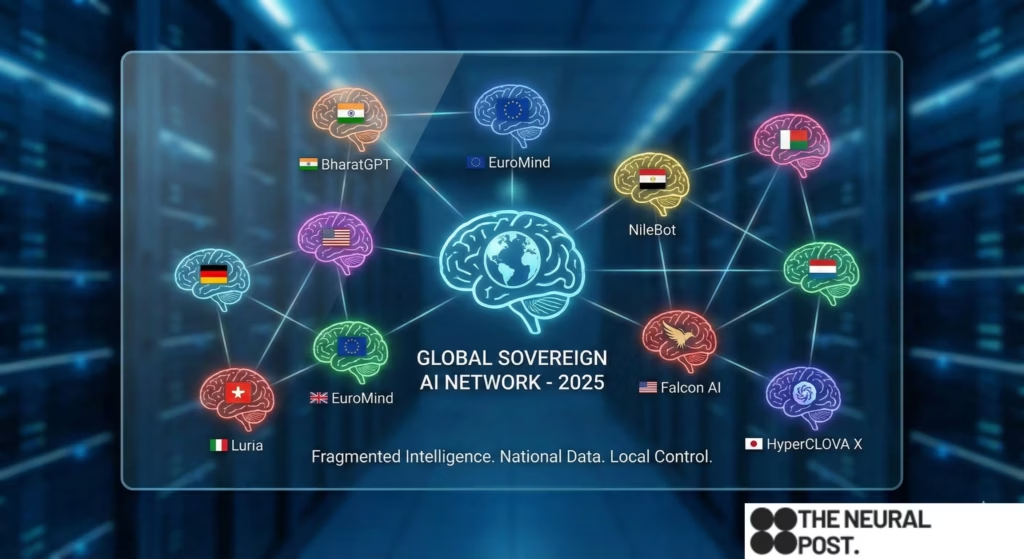
We are moving from Pax Americana to a fragmented world of Digital Empires. Here is why the Sovereign AI movement is the most important geopolitical shift of the decade.
1. The Realization: “Digital Colonialism”
The catalyst for this movement wasn’t pride; it was fear.
The fear is Digital Colonialism.
When a French user asks ChatGPT a question about history, the answer is filtered through a Californian lens. The “safety filters” reflect American Puritanism. The historical biases reflect American textbooks. The language nuances are translated from English, flattening the rich texture of French culture into a “Global English” average.
French President Emmanuel Macron saw this early. He realized that if France didn’t build its own models, the French language itself would become a second-class citizen in the digital age. It would be a “wrapper” language, processed by an American core.
This isn’t just about poetry. It’s about law.
If a French law firm uses an American AI, and that AI hallucinates a legal precedent based on US Common Law instead of French Civil Law, the system breaks.
Nations realized they were importing a foreign operating system for their society. And just as you wouldn’t let a foreign army run your power grid, you can’t let a foreign corporation run your cognitive infrastructure.
2. The European Champion: Mistral and the Defense of Culture
France’s answer was Mistral.
Mistral AI didn’t just happen. It was a strategic imperative, backed by the French establishment.2 When Mistral releases a model like Mistral Large 2, it is marketed differently than GPT-4.
- GPT-4 is sold as a tool for productivity.3
- Mistral is sold as a tool for independence.4
For European companies, Mistral is the “Compliance Shield.”5 Because it is built in Europe, it adheres natively to the GDPR (General Data Protection Regulation).6 It doesn’t secretly send data to a server farm in Iowa.
I recently spoke to a CIO of a major German automotive company. He told me, “We have banned ChatGPT. Not because it’s bad, but because we cannot have the blueprints of our next engine sitting on Microsoft’s Azure cloud. We run Mistral on-premise. It is ours.”
Europe is building a “Fortress AI.” They know they can’t beat the US on raw scale (Google has more chips), but they can win on Privacy and Sovereignty. They are betting that the world wants an alternative to the American surveillance model.
3. The Oil Pivot: UAE’s Falcon
If France is driven by culture, the United Arab Emirates (UAE) is driven by survival.
The Gulf states know the oil money won’t last forever. They are pivoting aggressively to become the “Data Center of the Global South.”
Their sovereign model is Falcon.
Developed by the Technology Innovation Institute (TII) in Abu Dhabi, Falcon isn’t a toy. At various points in 2024 and 2025, it topped the open-source leaderboards.
The UAE bought thousands of NVIDIA H100s (and now H200s), creating one of the densest compute clusters on earth.
Why? Because they want to be the Switzerland of AI.
The US has strict export controls.7 They won’t let China buy the best chips. They monitor what models go where.
The UAE positions Falcon as the “Neutral” option. It is a model for the nations that the US ignores or mistrusts.
- African nations building e-government services? Use Falcon.
- Southeast Asian startups priced out of OpenAI? Use Falcon.
The UAE is trading oil diplomacy for weight diplomacy. “We will give you the model weights if you trade with us.” It is soft power for the algorithmic age.
4. The Cultural Fortress: Korea’s HyperCLOVA X
South Korea offers perhaps the most fascinating case study in “hyper-localization.”
Naver, the “Google of Korea,” built HyperCLOVA X.8
Most Americans have never heard of it. But in Korea, it is a titan.
Why build it when GPT-5 exists?
Because GPT-5 is terrible at Korean context.
- GPT-5 can speak Korean, but it doesn’t understand the complex hierarchy of honorifics that define Korean social interaction.
- It doesn’t know the local celebrity gossip, the nuances of the “Jeonse” rental system, or the specific way Korean convenience store payments work.
HyperCLOVA X was trained on Naver’s massive internal dataset of Korean blogs, news, and search queries.9 It “feels” Korean.
When a Korean user asks for a restaurant recommendation, HyperCLOVA X knows that “good service” in Seoul means something very different than “good service” in San Francisco.
For “Daily Needs” AI—shopping, banking, chatting—the local model always wins.
Korea proved that Culture is a Moat. You can’t just translate English weights into Korean and expect it to work. You have to train from the ground up on the culture itself.
5. The “Great Firewall” of Intelligence
The consequence of this movement is the fragmentation of the internet.
We are seeing the rise of AI Blocs.
- The Western Bloc: US, UK, Canada, Australia (The “Five Eyes”).10 Relying on OpenAI/Anthropic/Google.
- The European Bloc: France, Germany.11 Rallying around Mistral and open-weights.
- The Chinese Bloc: DeepSeek, Alibaba Qwen. Completely severed from the Western internet, developing its own parallel ecosystem of chips and algorithms.
- The Non-Aligned Bloc: UAE (Falcon), India (developing BharatGPT). Trying to play both sides.
This means the “Global Truth” is dead.
If you ask a question about a geopolitical conflict:
- GPT-5 (US) will give a US-centric answer.
- Qwen (China) will give a CCP-approved answer.
- Falcon (UAE) might give a neutral, or Arab-centric answer.
We aren’t just seeing different search results; we are seeing different reasoning processes. The AI models are becoming nationalistic. They are being trained on “Patriotic Data.”
In 2026, we expect to see “Data Tariffs.”
Countries will pass laws saying: “Data generated by our citizens cannot be used to train foreign models.”
Japan is already making noise about this. They want Japanese anime and literature to train Japanese models, not to be scraped for free by Midjourney to generate profit for a US firm.
6. The Security Risk: When the Lights Go Out
Ultimately, the argument for Sovereign AI comes down to National Security.
Imagine a future war. It’s 2030.
The conflict isn’t fought with missiles, but with cyber-attacks and economic sanctions.
If a country relies entirely on Microsoft Azure and OpenAI for its banking system, its traffic grid, and its hospitals… what happens if the US government decides to cut access?
It is the “Kill Switch” scenario.
Russia learned this the hard way when SWIFT cut them off.
No major nation wants to be in a position where their intelligence infrastructure can be turned off by a sanction order from the White House.
This is why Japan is funding domestic chip manufacturing (Rapidus). This is why the UK is building its own “BritGPT” infrastructure.
They are building redundancy.
They are ensuring that even if the transatlantic cables are cut, their AI can still think.
Conclusion: The End of the Universal Machine
For the last ten years, Silicon Valley pitched the dream of the “Universal Machine.” One software stack to rule them all. Facebook connected everyone. Google searched everything.
That dream is over.
The future of AI is local. It is messy. It is guarded by borders.
We will have French AI, Korean AI, and Arab AI. They will not talk to each other easily. They will have different values, different truths, and different capabilities.
For the global traveler or the multinational corporation, this is a headache. You will need a “Passport” for your digital agents, ensuring they comply with the local AI regulations as they move from region to region.
But for the preservation of human diversity? It might be the only hope we have.
The Sovereign AI movement is a declaration that the future will not be homogenous.12 It will not be a flat, grey, San Francisco-colored world. It will be a world where nations fight—with silicon and code—to keep their own way of thinking alive.
And frankly, a world with a “French” opinion and a “Korean” opinion is a lot more interesting than a world where everyone just agrees with the machine in California.
