Last Updated on March 12, 2026 by The NP Team
By a Principal Systems Architect
Yesterday, I sat in a code review that felt like an archeological dig.
A Senior Engineer was walking me through his new architecture for a legal compliance bot. The diagram was a masterpiece of complexity: a document ingestion service, a semantic chunking pipeline, a re-ranking model, a hybrid search index using Weaviate, and a final synthesis step using GPT-4. It was a classic RAG (Retrieval Augmented Generation) pipeline.
“It looks robust,” he said proudly. “It handles our 500-page Employee Handbook perfectly. We only hallucinate about 4% of the time.”
I looked at the diagram. Then I looked at the monthly cloud estimate.
“Why are we building a Ferrari to cross the street?” I asked. “Why don’t we just paste the handbook into the prompt?”
He looked at me like I had suggested writing the code in Assembly. “Because of the context window!” he said. “And the cost! It would cost a fortune to send 500 pages for every question.”
In 2023, he would have been right. In 2024, he would have been cautious.
But in late 2025, he is mathematically wrong.
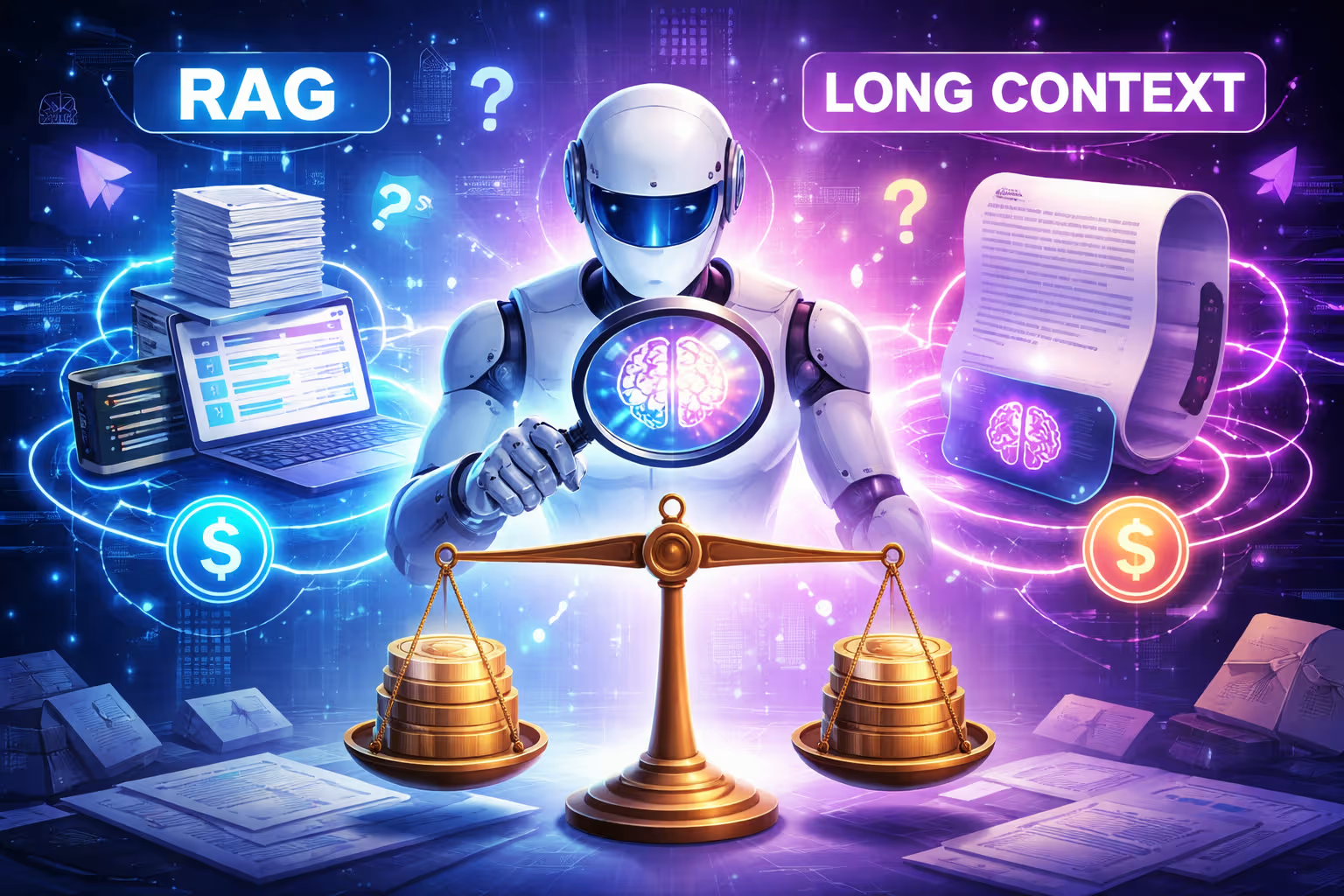
We have reached a tipping point in LLM economics that most engineering teams have missed. Context Caching and Massive Context Windows (like Gemini 1.5 Pro’s 2 Million+ tokens) have fundamentally inverted the “Rent vs. Buy” logic of information retrieval.
For any dataset under 1GB (which includes manuals, contracts, codebases, and most corporate wikis), RAG is now the expensive option.
Here is the brutal math on why it is cheaper, faster, and more accurate to feed the whole book to the model—and why you should probably delete your vector database.
1. The “Shredder” Problem: Why RAG Hallucinates
To understand the economics, you first have to understand the failure mode.
RAG was invented because models used to have tiny memories (4k to 32k tokens). To fit a 500-page manual into a 32k window, we had to use a Shredder.
We chopped the manual into 500-word “chunks.” We stored them in a vector database. When a user asked a question, we retrieved the “Top 3” chunks and hoped the answer was inside them.
This creates the Context Gap.
Imagine asking a human: “What is the maternity leave policy for fathers?”
The human opens the handbook.
- Page 40 says: “Fathers get 2 weeks.”
- Page 42 says: “See ‘Primary Caregiver Exception’ on Page 105.”
- Page 105 says: “If the father is the primary caregiver, they get 12 weeks.”
A RAG system retrieves Page 40. It might retrieve Page 42. It almost certainly misses Page 105, because Page 105 doesn’t contain the word “father.”
The result? The AI confidently tells you: “Fathers get 2 weeks.”
This is a Hallucination by Omission. The model didn’t lie; the retrieval system failed to give it the truth.
We spent years trying to patch this with “Knowledge Graphs” and “Recursive Retrieval.” We were building Rube Goldberg machines to compensate for the fact that the model couldn’t read the whole book.
Long Context solves this by brute force.
You upload Page 1 through Page 500. The model reads everything. It sees the link on Page 42. It jumps to Page 105. It reasons across the entire document.
It doesn’t miss the exception because it holds the entire universe of the document in its working memory.
2. The Math: Breaking Down the Token Economics
This is where the argument usually dies. “Okay, it’s more accurate,” the CFO says. “But I am not paying $5.00 per query to read a 500-page book.”
Let’s run the numbers for December 2025.
The Scenario:
- Document: 500-Page Technical Manual.
- Size: Approx 250,000 Tokens.
- Usage: 1,000 queries per day.
Option A: The RAG Architecture (The Old Way)
In a RAG system, you pay for the vector database, the embedding costs, and the “Context + Output” tokens for each query.
1. Infrastructure Costs:
- Vector DB (Pinecone/Weaviate): For a production-grade index with high availability: ~$100/month.
- Ingestion Pipeline: You need a server to parse PDFs and update embeddings. Let’s call it $50/month.
2. Variable Token Costs (GPT-4o):
- Input: You retrieve 5 chunks (approx 3,000 tokens) + System Prompt (1,000 tokens) = 4,000 tokens per query.
- Price: $2.50 / 1M input tokens.
- Math: 4,000 tokens * $2.50/1M = $0.01 per query.
Total RAG Cost (Monthly):
- Fixed: $150
- Variable: $0.01 * 30,000 queries = $300
- Total: $450 / month.
Option B: Long Context with Caching (The New Way)
Here is where the magic happens.
If you sent 250k tokens for every query, it would be expensive.
- 250k * $1.25/1M = $0.31 per query. (That is $9,300/month. The CFO was right).
BUT… Google introduced Context Caching.
With Context Caching (available in Gemini 1.5 Pro and Flash), you upload the manual once. You pay a “rental fee” to keep it in the model’s RAM.
Subsequent queries against that cache do not pay for the 250k tokens. They only pay for the new prompt.
1. The Cache Rental Fee:
- Storage Cost: $4.50 per 1M tokens per hour.
- My Doc: 0.25M tokens.
- Math: $4.50 * 0.25 = $1.12 per hour to keep the manual “hot.”
- Monthly Rental: $1.12 * 24 * 30 = $806 / month.
2. The Variable Query Cost:
- Input: You only send the user’s question (50 tokens).
- Price: $0.31 / 1M cached input tokens (discounted rate).
- Math: Negligible. Essentially free.
Wait, $806 is more than $450.
So RAG wins?
Not so fast.
We haven’t factored in the Engineering Overhead.
3. The “Hidden” Cost of RAG Complexity
The $450 RAG price tag assumes your system works perfectly. It never does.
The RAG Tax:
- Chunking Strategy: You will spend weeks arguing about whether to split by paragraph or by markdown header.
- Re-Ranking: Your users will complain the search sucks. You will install a Re-Ranking model (Cohere Rerank). That adds 100ms latency and $0.01 per query.
- Pdf Parsing: Parsing tables from PDFs is a nightmare. You will buy a subscription to a specialized OCR tool (like Unstructured.io) for $500/month.
- Maintenance: Every time the manual updates, your ingestion script breaks.
The Long Context Tax:
- Upload File.
- Cache File.
That’s it.
If I factor in just 10 hours of developer time per month to maintain the RAG pipeline (at $100/hr), the RAG cost jumps by $1,000.
Suddenly, the “expensive” Long Context cache ($806) looks like a bargain.
Furthermore, we can optimize.
Gemini 1.5 Flash exists.
- Cache Rental: $1.00 per 1M tokens/hr (approx).
- My Doc: 0.25M tokens.
- Rental: $0.25/hr -> $180 / month.
Gemini 1.5 Flash (Long Context) = $180/month.
RAG Pipeline = $450/month (Optimistic) to $1,500/month (Realistic).
For a 500-page manual, Long Context is cheaper, even before we talk about accuracy.
4. The Accuracy “Moat”: Needle in a Haystack
Cost is important, but Accuracy is liability.
The benchmark for Long Context is NIAH (Needle In A Haystack).
Can the model find a single sentence hidden in 1 million tokens?
Gemini 1.5 Pro scores 99.7% on NIAH tests.
The benchmark for RAG is Recall@K.
Does the retriever find the right chunk in the top 5 results?
For complex documents (legal/technical), standard RAG Recall is often around 75-85%.
That 15% gap is where the hallucinations live.
If the retriever misses the chunk, the LLM must hallucinate to answer the question. It has no choice.
With Long Context, the retrieval error is zero. The model has the data. It might still misunderstand it (reasoning error), but it won’t hallucinate because of missing data.
The “Holistic” Advantage:
Long Context models can do things RAG simply cannot.
- Prompt: “Summarize the tone shift between Chapter 1 and Chapter 10.”
- RAG: Fails. It only sees snippets.
- Long Context: Succeeds. It reads the whole arc.
- Prompt: “Find all inconsistent definitions of ‘User’ across these 50 contracts.”
- RAG: Fails. It can’t compare 50 documents simultaneously in its working memory.
- Long Context: Succeeds. It loads all 50 into the window and runs a diff.
5. When to Delete the Vector DB (and When to Keep It)
I am not saying RAG is dead. I am saying RAG is legacy code for small-to-medium datasets.
Delete the Vector DB If:
- Your Data fits in 2M Tokens: That is roughly 3,000 pages of text. That covers 95% of corporate use cases (Project Docs, HR Policies, Code Repos, Contracts).
- Your Data is “Dense”: If the answer requires reading multiple sections to understand the context (e.g., Legal, Medical, Engineering).
- You hate maintenance: You want a stateless, serverless architecture.
Keep the Vector DB If:
- The “Wikipedia Scale”: You have 100GB of data. You cannot cache 100GB. You need retrieval to find the relevant 10MB, then maybe use Long Context.
- High Velocity Updates: If your data changes every second (e.g., Stock tickers, Twitter feed), caching is inefficient because you have to invalidate the cache constantly.
- Low Latency Search: If you just need keyword search (“Find the invoice #1234”), ElasticSearch/Vector is faster than an LLM reading a book.
6. Implementation Guide: The “Hybrid” Future
So, how do you implement this today?
Step 1: The Context Router
Don’t blindly send everything to the cache. Build a router.
- If Input_Size < 30k tokens: Just send it raw (No cache needed).
- If Input_Size > 30k tokens: Create a Cache Key (Time-To-Live: 1 hour).
Step 2: The “Flash” First Strategy
Start with Gemini 1.5 Flash. It is significantly cheaper and faster than Pro.
Only upgrade to Pro if the reasoning is complex (e.g., legal analysis vs. simple summary).
Step 3: The Cache Refresh Policy
Context Caching charges by the hour.
If no one asks a question for 60 minutes, the cache dies.
You need a “Keep-Alive” or “Just-In-Time” strategy.
- Corporate Intranet: Spin up the cache at 8:00 AM. Kill it at 6:00 PM. You save 50% on costs.
Conclusion: Complexity is the Enemy
We engineers love complexity. We love building pipelines. We love tuning HNSW parameters in Pinecone. It makes us feel like we are doing “Real Engineering.”
But the best engineering is the one that delivers value with the least moving parts.
Uploading a file to an API is boring.
It is also robust, accurate, and surprisingly cheap.
In late 2025, the most dangerous thing you can do is cling to the architectures of 2023.
The hardware (or in this case, the virtual hardware of the Context Window) has evolved.
Stop shredding the book. Just let the robot read.
