Last Updated on December 16, 2025 by The NP Team
The Smart Fridge Is Dead. Long Live the “Dumb” Puck.
For the last twenty years, the “Smart Fridge” has been the laughingstock of the Consumer Electronics Show (CES). You know the pitch: a $4,000 stainless steel monolith with a giant iPad glued to the door that promises to tweet you when you run out of milk. It never worked. Nobody wanted to manually log the expiration date of their yogurt into a slow touchscreen interface while trying to make breakfast. It was the epitome of “Solutionism”—tech looking for a problem and missing.
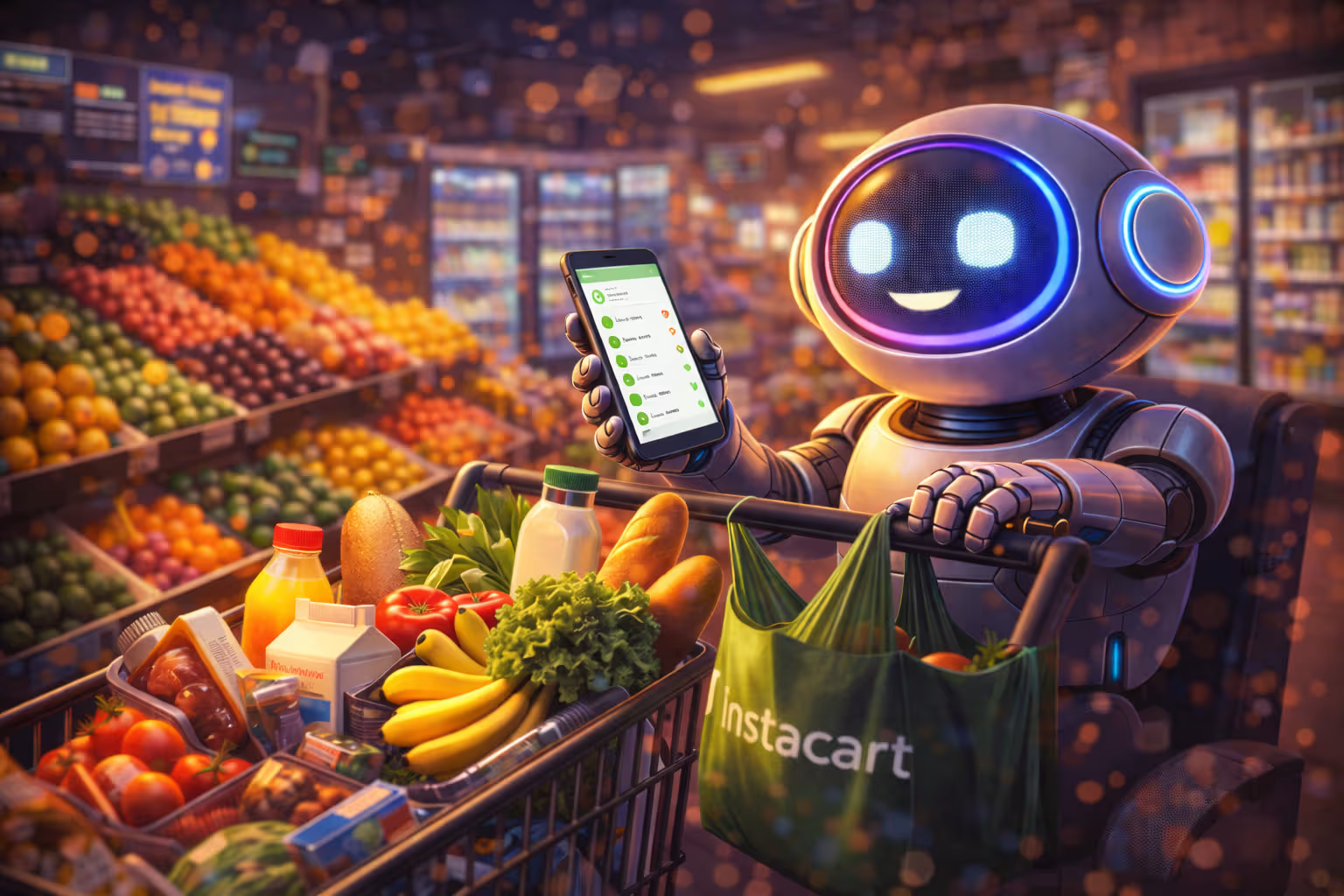
But in late 2025, the Smart Fridge finally arrived. It just didn’t come from Samsung or LG. It came from Instacart, it costs $49, and it looks like a hockey puck that got stuck to the inside of your door.
This is the Instacart “FridgeBot” Puck.
It is part of the new wave of “Edge AI” hardware—devices running quantized, small language models (in this case, a stripped-down version of Meta’s Llama 3.3) locally on cheap chips. It doesn’t try to be a portal to the metaverse. It has one job: watch what you take out, watch what you put back, and make sure you never have to think about buying eggs again.
I handed over total control of my grocery supply chain to this plastic disc for 30 days. I expected it to be a disaster of hallucinated orders and rotting vegetables. Instead, I found the first AI use case that actually improved my life by being aggressively boring.
Here is the harsh, honest truth about living with a robot grocer.
1. The Hardware: A $50 Eye in Your Salad Drawer
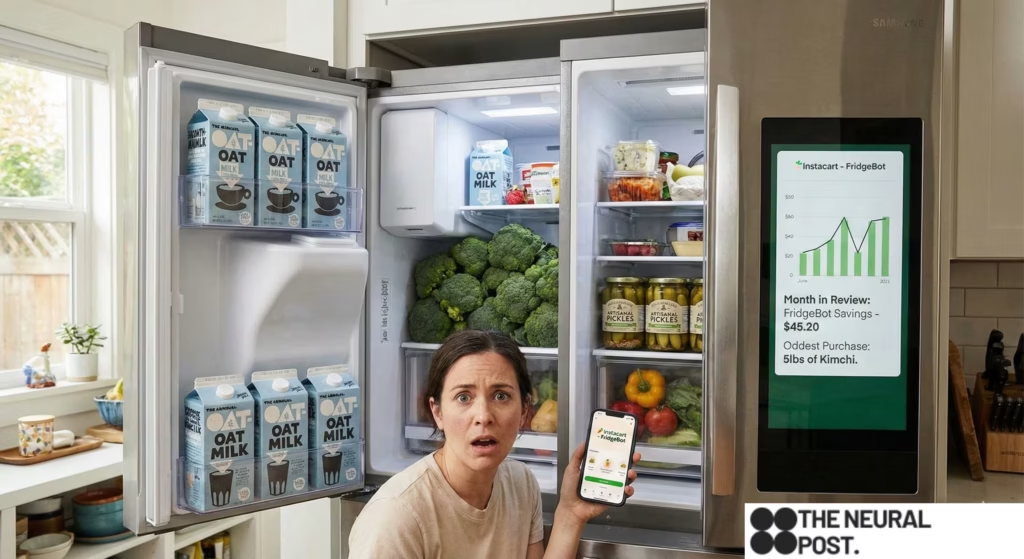
The FridgeBot Puck is underwhelming to look at. It’s a matte white disc, about the size of a smoke detector, with a fisheye camera lens and a motion sensor. You don’t plug it in (the battery lasts 6 months), and you don’t need a new fridge. You just magnetically slap it onto the inside wall of your existing refrigerator.
The genius here is the “Viewpoint.” Unlike previous smart fridges that tried to use weight sensors on shelves (which failed if you moved things) or external barcode scanners (which required you to act like a cashier in your own home), the Puck uses Computer Vision.
When you open the door, the light turns on. The Puck wakes up. It snaps a wide-angle burst of photos of your shelves. It compares these photos to the “State of the Fridge” from the last time the door was closed.
It notices that the milk carton is physically lighter (using a surprisingly accurate depth-estimation algorithm). It notices the bag of spinach has moved from “crisp” to “slightly wilted.” It sees the empty space where the butter used to be.
The Setup: Painless Invasion
Setting it up took five minutes. You pair it with the Instacart app, you take a “calibration photo” of your empty fridge (which feels weirdly intimate), and then you fill it up.
The first week is the “Learning Phase.” The AI doesn’t order anything yet. It just watches. It learns that I buy oat milk, not dairy. It learns that I ignore the jar of pickles in the back (the “Ghost Zone”). It learns that I go through a dozen eggs every four days.
This passive data collection is the key. The old smart fridges failed because they required active input. The Puck is a surveillance state for your condiments. It works because it requires zero effort from you—other than the creepy feeling that your mustard is being watched.
2. The Brain: Llama 3.3 on the Edge
The secret sauce isn’t the camera; it’s the model. The Puck runs a highly quantized version of Llama 3.3 (8B parameter).
Why does your fridge need an LLM? Because “vision” alone isn’t enough. You need context.
Old computer vision could tell you “This is a red object.”
Llama 3.3 looks at that red object, checks the timestamp of when it first appeared, analyzes the slight wrinkling of the skin, and determines: “This is a bell pepper. It was bought 9 days ago. It is entering the ‘danger zone’ of freshness. Probability of usage in next 24 hours: Low. Action: Flag for ‘Use It Or Lose It’ notification.”
This is the distinction between “Object Detection” and “Daily Needs Reasoning.”
During my testing, I tried to trick it. I put a half-eaten sandwich wrapped in foil on the shelf.
The Puck didn’t log it as “Unknown Object.” It logged it as “Leftovers (Foil Wrapped). Created: Tuesday 7 PM.”
How did it know? Because it saw me put the foil over the sandwich on the counter (via a second Puck I installed in the pantry/prep area—part of the “Kitchen Mesh” upsell) before placing it in the fridge.
It tracks object permanence. It understands that “Food” becomes “Leftover” becomes “Trash.”
3. The “Auto-Refill” Experience: Trust Fall
By Week 2, I enabled “Auto-Order.” This is the terrifying part. You give the AI permission to spend your money without asking.
You set a budget (I set mine to $150/week) and a “sensitivity” level (I chose “Aggressive” because I hate running out of coffee).
The First Success:
On a Tuesday, I opened the fridge to grab a La Croix. There was one left. I drank it.
Two hours later, I got a notification: “Instacart Order Placed: La Croix (Pamplemousse), Greek Yogurt, 2 Avocados. Arriving tomorrow, 5-7 PM.”
I hadn’t realized I was low on yogurt. The Puck saw that the tub was nearly empty (likely based on the angle it was sitting or the fact that I had scraped the sides).
The order arrived. The seamlessness was intoxicating. I felt like a billionaire with a silent house staff.
The First Failure (The “Kale Problem”):
On Friday, the system ordered three bunches of kale.
Why? Because I had bought kale the previous two weeks and eaten it. The pattern matching said “User consumes Kale weekly.”
But I didn’t want kale this week. I was sick of kale. I wanted pizza.
The AI cannot predict cravings. It can only predict patterns.
This is the fundamental flaw of “Daily Needs” models. They assume humans are deterministic machines. We aren’t. We are chaotic biological entities who suddenly decide we hate broccoli after loving it for six months.
I had to manually cancel the kale order. The friction of “un-shopping” is almost as annoying as shopping.
4. The Food Waste Killer: “Eat This Now”
If the Auto-Order is the flashy feature, the “Eat This Now” notification is the actual game-changer.
We all have the “Rotter Drawer.” You buy expensive produce, put it in the crisper, forget about it, and find it two weeks later as a bag of brown slime.
The FridgeBot declares war on the Rotter Drawer.
Because it tracks the entry date of every item, it builds a dynamic expiration timeline.
On Thursday night, my phone buzzed.
“Urgent: Your Salmon fillets (2 days old) and Asparagus (5 days old) need to be cooked tonight. Here is a recipe for Pan-Seared Salmon with Lemon Asparagus that takes 15 minutes.”
It didn’t just tell me the food was dying; it gave me a solution.
It linked directly to the “Nano Banana Pro” visualized recipe generator (Google’s integration is everywhere these days), showing me exactly what the meal would look like using only the ingredients I currently had.
I cooked the salmon.
Without that nudge, I would have ordered takeout, and $25 worth of groceries would have gone in the trash on Saturday.
The Math:
Over the month, I estimate the “Eat This Now” feature saved me about $120 in prevented food waste. The Puck costs $49. The ROI (Return on Investment) was reached in less than two weeks.
5. The “Brand Loyalty” Trap
We need to talk about the corporate incentives here. Instacart is not a charity. They are an advertising platform.
I noticed a subtle bias in the Auto-Refills.
When I ran out of generic store-brand ketchup, the FridgeBot didn’t auto-order the generic. It added “Heinz” to the cart.
When I ran out of standard pasta, it queued up a “High Protein Artisan” brand that cost $2 more.
When I dug into the settings, I found a toggle buried deep in the menu: “Allow Sponsored Suggestions.” It was on by default.
The AI is “aligned” to keep you fed, yes. But it is also “aligned” to upsell you. It exploits your laziness. If it adds the expensive ketchup, are you really going to take the time to swap it out? Probably not. You just click “Confirm.”
This is the “Convenience Tax.” You save time, but you pay a premium on the goods. The AI is a personal shopper that gets a kickback from the brands it buys.
6. The Privacy Nightmare: The Kitchen Panopticon
Let’s not sugarcoat it: I put a camera in my kitchen that is owned by a data broker.
The Puck processes images “on-device” (according to the marketing), but the metadata—what I eat, when I eat, how fast I consume alcohol, what brand of baby formula I use—is uploaded to the cloud to train the “Global Consumption Model.”
This data is radioactive.
- Health Insurance: Could an insurer buy this data to see that I eat red meat five times a week and raise my premiums?
- Targeted Ads: Start drinking more wine than usual? Expect ads for depression medication or divorce lawyers to start popping up on your Instagram.
The “Privacy Shutter” on the Puck is a physical plastic slide you can close. But if you close it, the device stops working.
I found myself “performing” for the fridge. I hid the bag of midnight shredded cheese in the back so the bot wouldn’t judge my 2 AM snack habits. I realized I was modifying my behavior to please the algorithm.
7. The “Pantry Puck” and The Ecosystem
I eventually expanded the test to the “Pantry Puck”—a second unit for dry goods.
This was less successful.
Pantries are chaotic. Bags of flour, stacks of cans, boxes of cereal turned sideways. Computer vision struggles with “pile of stuff.”
The Pantry Puck constantly thought I was out of rice because the rice bag was behind the pasta box. It ordered three bags of jasmine rice before I disabled it.
Lesson: The Fridge is a structured environment (shelves, door pockets). The Pantry is the Wild West. Visual AI works in structure; it fails in chaos.
8. The Verdict: The “Good Enough” Revolution
So, is FridgeBot the future?
Surprisingly, Yes.
It is not the sci-fi dream of a humanoid robot cooking your dinner. It is something more practical: a background process that manages inventory.
For the past decade, we have been promised “Superintelligence.” We expected AI to cure cancer and write symphonies.
But it turns out, I don’t need a symphony. I need someone to remember that I’m out of butter.
FridgeBot succeeds because it embraces “Dumb AI.”
It doesn’t try to converse with me. It doesn’t have a personality. It doesn’t try to be my therapist (looking at you, ChatGPT Voice). It just counts the eggs.
The Pros:
- Waste Reduction: The “Eat This Now” notifications are genuinely useful and eco-friendly.
- Mental Load: Offloading the “What do we need?” cognitive task is a massive relief for parents or busy professionals.
- The Hardware: The magnetic, battery-powered form factor is perfect. No installation anxiety.
The Cons:
- The Upsell: It will try to buy expensive brands if you aren’t watching.
- The Privacy: You are feeding the ad-tech beast your most intimate dietary habits.
- The “Kale” Factor: It cannot predict spontaneous human desire.
Final Score: 4/5 Stars.
I intended to return the Puck after the 30-day review period ended.
I didn’t.
It’s still on my fridge door.
Because yesterday, I ran out of milk. Or I would have run out of milk, but there was a fresh carton sitting on the porch that I didn’t remember ordering. And that feeling—that tiny moment of friction removed from my day—is worth the $49 and the creepy surveillance.
The AI didn’t take my job. It just took my grocery list. And it can have it.
Technical Addendum: The “Llama-Edge” Stack
For the nerds reading this, the technical achievement of the Puck is worth noting.
- Model: Llama 3.3 (8B), 4-bit quantization.
- Chip: Qualcomm “Kitchen-IoT” specialized NPU.
- Vision: Single-shot inference. It does not stream video. It wakes on accelerometer trigger (door opening), buffers 3 frames, selects the sharpest, runs inference, and sleeps.
- Battery Life: The aggressive sleep cycling is how it gets 6 months on a lithium-ion pack.
- Connectivity: It uses Matter over Thread to connect to your home hub, offloading the heavy API calls (ordering) to your phone/router rather than the device itself.
It is a masterclass in efficient engineering. It proves that we don’t need massive data centers for everything. Sometimes, a smart camera with a tiny brain is enough.
