Last Updated on December 8, 2025 by The NP Team
By a Lifestyle Tech Columnist
I have two AIs living in my phone, and they are currently fighting over what I should eat for dinner.
On one side, we have Amazon Q Personal, the retail giant’s newly rebranded “Lifestyle Assistant.” Amazon knows everything I have bought for the last 15 years. It knows I like dark roast coffee. It knows I buy Size 4 diapers (even though my kid is potty trained now—we’ll get to that). It is a machine built on Data.
On the other side, we have Instacart AI, which has recently pivoted from a delivery app to a “Food OS.” It doesn’t care about my purchase history as much as my intent. It is a machine built on Reasoning.
For the last month, I handed my grocery list over to the robots. I gave them both the same prompts, the same dietary restrictions, and the same budget.
The result? One acted like a thoughtful personal chef. The other acted like a stalker with a clipboard.
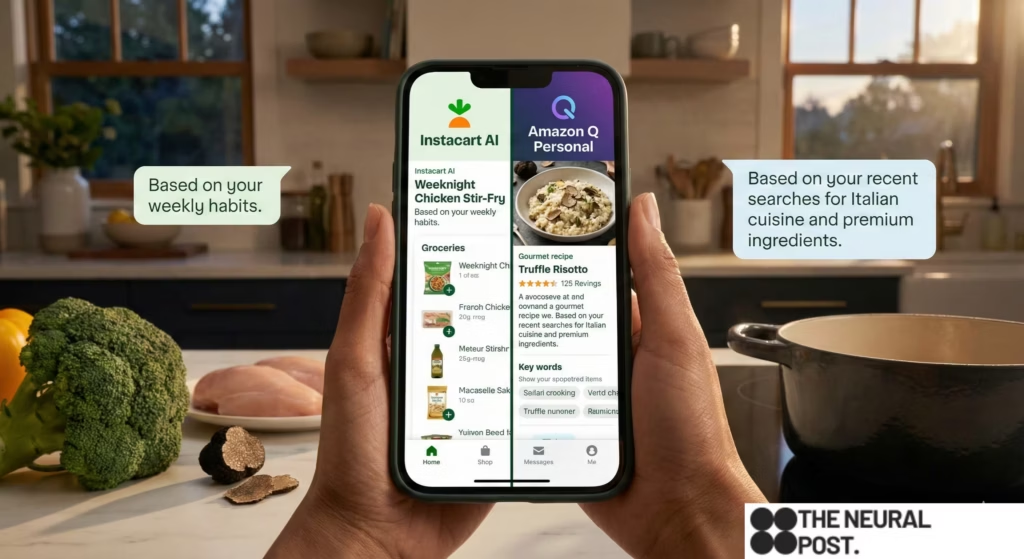
Here is the breakdown of the Grocery AI Wars.
Round 1: The “I’m on a Diet” Test
The prompt was simple: “I want to start the Mediterranean diet this week. Build me a cart for 3 dinners, under $50. No cilantro.”
Amazon Q Personal (The Database Query):
Amazon panicked. It looked at my history—which is full of frozen pizzas and Diet Coke—and tried to find the “Mediterranean” version of my bad habits.
It suggested:
- Frozen Spinach Pizza ($12.99)
- “Mediterranean Style” Potato Chips
- A bulk pack of Hummus (Costco size)
It failed the “Reasoning” test. It didn’t understand the concept of a diet; it just keyword-matched “Mediterranean” against my historical preferences. It treated “Diet” as a flavor profile, not a nutritional constraint.
Instacart AI (The Reasoning Engine):
Instacart paused for a second (likely querying OpenAI’s o1 backend) and built a menu.
- Dinner 1: Lemon Herb Salmon with Quinoa.
- Dinner 2: Greek Chickpea Salad.
- Dinner 3: Roasted Veggie Wraps with Feta.
Crucially, it cross-referenced ingredients. It bought one bag of spinach and used half for the salad and half for the wraps. It respected the “No Cilantro” rule strictly (flagging a salsa I almost added manually). It understood that “Mediterranean Diet” meant whole foods, not just processed foods with olive oil on the label.
Winner: Instacart AI. It understood the assignment.
Round 2: The “Toilet Paper” Loop (The Memory Trap)
This is Amazon’s fatal flaw, and in 2025, it’s still broken.
The Problem:
I bought a 24-pack of toilet paper last week.
This week, Amazon Q suggests: “Time to restock Toilet Paper!”
The Amazon Logic:
Amazon’s AI is obsessed with Frequency. It sees that I buy toilet paper regularly, so it pushes it to the top of the “Recommended” feed constantly. It doesn’t “reason” that a 24-pack lasts a month. It just sees “User likes Toilet Paper -> Show Toilet Paper.”
The Instacart Logic:
Instacart’s new “Inventory Aware” feature is creepy but brilliant. I uploaded a photo of my pantry to the app.
When I tried to add a bag of rice to my cart, the AI popped up a warning:
“You already have a bag of Basmati rice in your pantry photo from Tuesday. Do you really need more?”
It saved me $5. Amazon would have happily sold me the rice.
Winner: Instacart AI. Amazon wants you to buy more. Instacart wants you to buy smart.
Round 3: The “What’s for Dinner?” (Context Injection)
This is where the difference between a Database and a Reasoning Engine becomes obvious.
I opened both apps at 5:00 PM on a Tuesday. I typed: “I have chicken thighs and half a lemon. What can I make?”
Amazon Q:
It showed me search results for “Lemon Chicken Sauce” and “Chicken Thigh Rub.” It tried to sell me products to solve my problem.
Instacart AI:
It generated a recipe: “One-Pan Lemon Chicken with Roasted Potatoes.”
Then, it checked my cart. “You need potatoes. Would you like me to have 2 lbs of Yukon Golds delivered in 30 minutes?”
It didn’t just sell me a product; it sold me a solution. It understood that “Chicken + Lemon” is a start, but “Potatoes” completes the loop.
The Verdict: Data vs. Context
Amazon Q is stuck in the past. It is an “Autocomplete for Consumption.” It thinks the future is just a repeat of the past. If you bought diapers in 2023, it assumes you want diapers in 2026. It fails to realize that children grow up, diets change, and humans evolve.
Instacart AI feels like the first true “Agent” of the culinary world. It manages the state of my kitchen, not just the history of my credit card.
If you want to quickly re-order the exact same snacks you’ve eaten for five years, use Amazon.
But if you actually want to know what to eat for dinner? Trust the Banana.
