Last Updated on December 14, 2025 by The NP Team
By a Startup CTO
I had a painful meeting with my CFO last week. She put a graph on the screen showing our cloud spend. The line for “OpenAI API” wasn’t just going up; it was vertical.
“We are spending more on API credits than we are on our engineers,” she said.
She wasn’t wrong. For the last two years, my startup followed the standard Silicon Valley playbook: “Don’t optimize early. Just wrap GPT-4.” It was good advice in 2023. It allowed us to ship features in days. We didn’t need machine learning engineers; we just needed prompt engineers.
But we are not a prototype anymore. We are processing 50 million tokens a day. And at that scale, the “Rent the Genius” model is bleeding us dry.
So, for the last month, I went down the rabbit hole. I tasked my team with a simple question: Can we replace our expensive GPT-5 pipeline with a fine-tuned, “dumb” Llama 3 model running on our own metal?
The answer is yes. But the math is more complicated than just comparing price per token.
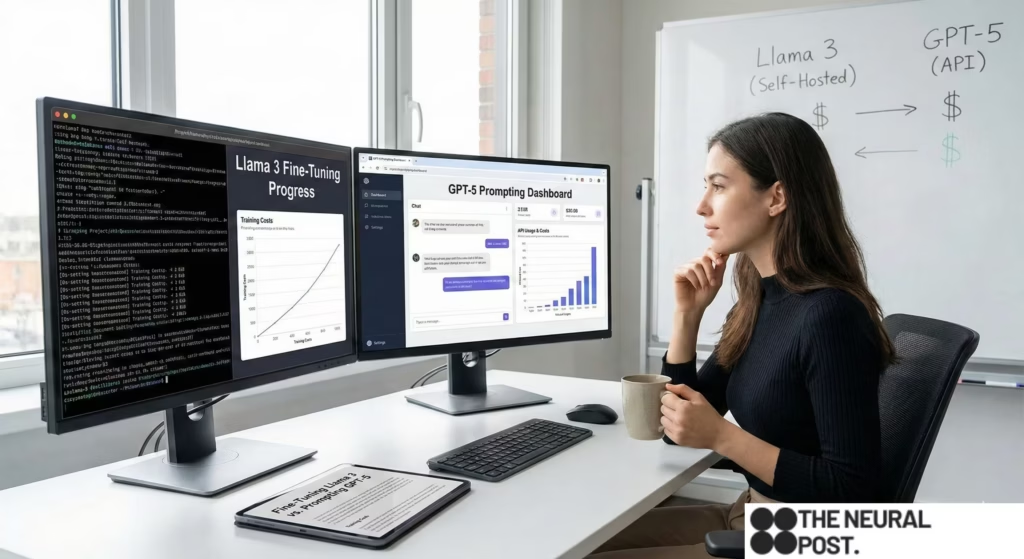
Here is the “Rent vs. Buy” analysis for AI in 2026.
1. The “Rent the Genius” Model (GPT-5)
Let’s start with the incumbent. GPT-5 (and its peers like Claude 3.5 Opus) is a general-purpose genius. It knows how to write Python, speak Swahili, and diagnose rare diseases.
When you use GPT-5 for a specific task—say, extracting data from invoices—you are hiring Einstein to do data entry.
The Pros:
Zero Infrastructure: You send a JSON request; you get a JSON response. No servers to manage.
Reasoning Capability: It handles edge cases beautifully. If an invoice is handwritten and upside down, GPT-5 figures it out.
No Training Data Needed: You just write a prompt.
The Cons: The “Intelligence Tax”
The problem is that you are paying for all of Einstein’s brain, even when you only need him to add two numbers.
The Cost Breakdown (2026 Prices):
Input: $5.00 / 1M tokens
Output: $15.00 / 1M tokens
If you have a prompt that is 2,000 tokens long (because you have to explain the task in detail and give 5 examples), and you run 10,000 requests a day:
Daily Cost: $100 (Input) + $300 (Output) = **$400/day**.
Annual Cost: $146,000.
That’s a senior engineer’s salary spent on a single feature.
2. The “Train the Intern” Model (Fine-Tuning Llama 3)
Now look at Llama 3 (8B).
Out of the box, it’s stupid compared to GPT-5. It hallucinates. It forgets instructions.
But Llama 3 is like a fresh college grad. It’s cheap, eager, and capable of learning one specific thing perfectly.
We decided to fine-tune Llama 3 8B specifically for our invoice extraction task.
The Hidden Superpower: Token Reduction
This is the part nobody talks about.
With GPT-5, I need a massive System Prompt (“You are an invoice parser. Here are the rules. Here is an example…”).
With a fine-tuned model, I can delete the System Prompt.
The model knows it is an invoice parser. It’s baked into the weights.
I send only the invoice text.
My input payload drops from 2,500 tokens to 500 tokens.
This is the multiplier. I’m not just paying less per token; I’m using 5x fewer tokens.
The Cost Breakdown (Hosting on Groq/Together):
Inference Cost: $0.10 / 1M tokens (approx).
Input Volume: reduced by 80%.
Daily Cost: $1.50.
Annual Cost: **$547**.
The Savings: 99.6%.
3. The “Hidden” Costs of Fine-Tuning
If the math is that good, why isn’t everyone doing it?
Because the sticker price of inference is a lie. It ignores the “CapEx” of training.1
To get that Llama 3 model, we had to:
Curate Data: We needed 1,000 perfect examples of “Invoice -> JSON.” This took two engineers a week to clean and verify. (Cost: $5,000 in time).
Rent Compute: We rented an H100 cluster for a few hours to run the training. (Cost: $100—negligible).
Evaluate: We had to build a testing harness to ensure the new model wasn’t hallucinating. (Cost: $2,000 in time).
Total One-Time Cost: ~$7,100.
So, the real math is:
GPT-5: $146k/year (Opex).
Llama 3: $7k (One-time) + $500/year (Opex).
The payback period is about three weeks.
4. The “Latency” Argument (Why Speed Matters)
There is another factor that drove us away from OpenAI: Speed.
GPT-5 is slow. It “thinks.” A complex request takes 2-5 seconds.
Our fine-tuned Llama 3 8B model, running on Groq’s LPU (Language Processing Unit) hardware, generates tokens at 800 tokens per second.
The response is instantaneous.
For our users, the app feels “native.” There is no spinner.
We realized that Latency is a feature. Users perceive a dumb-but-fast model as “better” than a smart-but-slow model for simple tasks.
5. The “Sovereign” Argument (Sleep at Night)
Finally, there is the issue of Dependency Risk.
Last November, OpenAI had a partial outage. Our entire product went down. We had angry customers tweeting at us. We were helpless.
We were renting our core competency.
By moving to Llama 3, we own the weights. We have the file final_model.gguf sitting on our S3 bucket.
If Together AI goes down, we can spin up the model on AWS. If AWS goes down, we can run it on a Mac Mini in the office.
We have achieved Model Sovereignty. We are no longer a wrapper; we are a technology company.
6. When Not to Fine-Tune (The Trap)
I don’t want to sound like a Llama maximalist. We still use GPT-5 for 20% of our workload.
Do NOT fine-tune if:
The Task Varies: If the user asks open-ended questions (“Help me write a marketing strategy”), Llama 3 8B will fail. It lacks the world knowledge.
Low Volume: If you only do 100 requests a day, the $7,000 setup cost isn’t worth it. Just pay the $5 to OpenAI.
Reasoning Heavy: If the task requires logic puzzles, math, or complex code generation, the “Genius” models still win.2
Conclusion: The Hybrid Future
The future of AI infrastructure looks like a Barbell Strategy.
On one end, you have the Heavy Lifters: GPT-5, Opus, Gemini Ultra. You use these for the hard stuff—strategy, creative writing, complex reasoning. You pay the premium because you have to.
On the other end, you have the Specialist Swarms: Dozens of tiny, fine-tuned Llama/Mistral models.
One model just extracts dates.
One model just writes SQL queries.
One model just classifies customer sentiment.
These models are fast, free, and run on your own metal.
If you are a startup in 2026, your goal should be to move as much workload as possible from the “Genius” to the “Interns.”
Stop paying Einstein to sweep the floor. Train the intern.
Recommended Tool: Axolotl
(This is the config-based library we used to fine-tune Llama 3 without writing complex PyTorch code. Highly recommended).
