

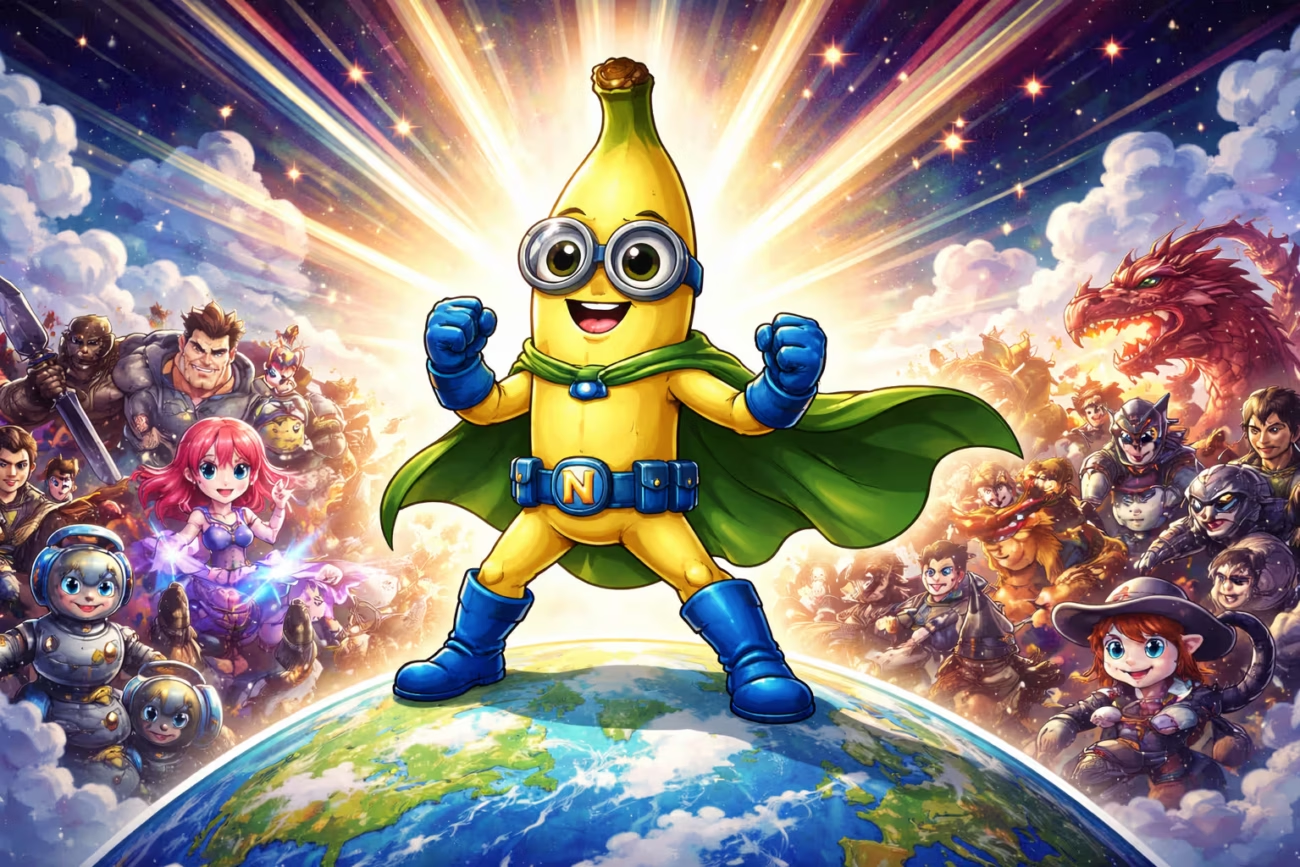
The “Slot Machine” Problem is Over
For the last three years, trying to make a comic book or a storyboard with AI has been an exercise in gaslighting. You generate a character—let’s call him “Detective Jack.” He looks gritty, he has a scar on his left cheek, and he wears a trench coat. You fall in love with the design.
Then you ask the AI for “Detective Jack drinking coffee.”
Suddenly, Jack has a different nose. The scar has moved to the right cheek. He looks ten years younger. He isn’t Jack anymore; he is Jack’s cousin who just graduated from modeling school. This is the “Slot Machine Problem.” Every prompt is a new pull of the lever. The AI doesn’t know “Jack”; it only knows the statistical probability of “Man in Trench Coat.”
Midjourney tried to fix this in 2024 with the –cref (Character Reference) tag. It was a valiant effort. It got us 80% of the way there. But that last 20%—the subtle drift in bone structure, the way eyes change shape in profile—kept AI art firmly in the realm of “dream sequences” rather than narrative storytelling.
Enter Nano Banana Pro (Gemini 3 Image).
In my previous review, I praised its physics engine. But over the last week, I have been testing its “Entity Persistence” feature (specifically the “Character Rig” workflow), and I am ready to make a bold claim: The era of the “shifting face” is dead.
Nano Banana doesn’t just match pixels to a reference image. It builds a temporary, invisible 3D mesh of your character’s head and body, locks it, and paints over it. It is no longer guessing what Detective Jack looks like from the side. It is rotating a 3D model of Detective Jack and rendering it.
Here is how Google solved the hardest problem in AI art, and why comic book artists are about to have a very complicated relationship with this tool.
1. The Technology: “Pixel Matching” vs. “Volumetric Locking”
To understand the breakthrough, we have to look at how the competition fails.
The Midjourney Approach (The Police Sketch Artist):
When you use –cref in Midjourney, the model looks at your reference image and extracts high-level features: “Blue eyes, wide jaw, stubble, scar.”1 When you ask for a new angle, it tries to reconstruction a face that matches that list of features.
It is like a police sketch artist drawing the same suspect from memory over and over. They get the vibe right, but the geometry drifts. In Panel 1, the nose is aquiline. In Panel 3, it’s a button nose. The “Soul” of the character flickers.
The Nano Banana Approach (The Digital Sculptor):
Nano Banana uses its “World Simulator” engine. When you upload a reference sheet (Front, Side, 45-degree angle), the model performs a “Photogrammetric Inference.” It estimates the depth map and bone structure of the subject.
It creates a “Volumetric Lock.”
When you ask for “Detective Jack looking up at the rain,” it doesn’t hallucinate a face looking up. It mentally tilts the 3D volume of Jack’s head 45 degrees back, calculates how the skin stretches over that specific jawline, and then applies the texture.
The difference is subtle in one image, but staggering across fifty.
2. The Stress Test: “The 50-Panel Comic”
I didn’t want to test this on a single portrait. I wanted to break it. I decided to create a 10-page graphic novel excerpt featuring a character named “Elara”—a cyberpunk courier with a very specific asymmetrical haircut (shaved on the left, long neon-blue on the right) and a distinctive facial tattoo.
Asymmetry is the kryptonite of AI. Models love symmetry. They usually “fix” asymmetrical haircuts by panel three.
The Setup:
I fed Nano Banana Pro three sketches of Elara (Front, Side, Back). I labeled this asset “Entity: Elara.”
The Panels:
Panel 1 (Extreme Close Up):
Prompt: “Elara screaming, extreme emotional distress, rain on face.”
Result: Flawless. The tattoo distorted correctly with the grimace. The shaved side of the head remained on the correct side (the left), which is a miracle in itself.
Panel 12 (Distant Action):
Prompt: “Elara jumping between rooftops, wide shot, night.”
Result: Usually, AI turns distant faces into “potato mush.” Nano Banana kept the silhouette of the hair perfectly consistent. Even at 50 pixels wide, the blue hair was on the correct side.
Panel 24 (The “Costume Change”):
Prompt: “Elara wearing a formal evening gown, sipping champagne, high society party.”
Result: This is where Midjourney usually fails—it blends the “cyberpunk” clothing style into the face. Nano Banana successfully separated “Character” from “Outfit.” It put Elara’s exact head (cyberpunk hair and all) onto a distinct body wearing a dress. The neck seam was invisible.
Panel 50 (The “Aging” Test):
Prompt: “Elara, 20 years later, scarred and old.”
Result: It kept the bone structure. It added wrinkles to her specific eye shape. It didn’t just generate a generic “old woman.” It looked like Elara had actually aged.
The Drift Factor:
In 50 panels, I had to discard only 4 images due to character inconsistency. With Midjourney v7, I typically discard 30 out of 50. The efficiency gain is astronomical.
3. The Workflow: The “Turnaround Tax”
There is a catch. Of course there is.
Midjourney is “Pick Up and Play.” You type, you get art.
Nano Banana Pro is “Setup and Execute.”
To get this consistency, you cannot just describe the character in text. You must provide the model with a “Turnaround Sheet” (a reference image showing the character from multiple angles).
If you don’t have a turnaround sheet? You have to generate one first.
The Workflow Loop:
Generation Phase: Spend 2 hours generating the “Perfect Elara” from the front, side, and back.
Ingestion Phase: Upload these to Nano Banana’s “Asset Vault.” The model spins for 5 minutes “indexing” the geometry.
Execution Phase: Now you can prompt “Elara eating a burger,” “Elara flying a plane,” etc.
This front-loads the work. It feels less like “prompting” and more like “Pre-Production” in a film. You are casting your actor before you start filming.
For a casual user, this is annoying. For a professional graphic novelist, this is the workflow we have been screaming for.
4. Comparison: Midjourney v7 vs. Nano Banana
Let’s look at the specific nuances of how they handle consistency.
| Feature | Midjourney v7 (–cref) | Nano Banana Pro (Entity Lock) |
| Face Shape | 85% Consistency. Tendency to “beautify” or average out features over time. | 99% Consistency. Keeps “ugly” features (big noses, weak chins) locked tight. |
| Hair Consistency | Struggles with complex/specific styles. Often changes length. | Understands hair volume as a 3D mass. Keeps asymmetrical cuts correct. |
| Clothing Bleed | High. If the character wears red in the ref, they usually wear red in the result. | Low. You can swap outfits easily while keeping the face. |
| Lighting | Tends to bake the reference lighting into the new image. | Relights the “mesh” perfectly to match the new scene. |
| Setup Time | 0 minutes (Just URL). | 10-20 minutes (Asset Indexing). |
The “Reference Burn” Effect:
Midjourney suffers from “Reference Burn.” If your reference photo has strong purple lighting, your generated images will fight to keep that purple lighting, even if you ask for “sunny day.”
Nano Banana strips the lighting data from the geometry data. It extracts the shape of the face, not the pixels of the face. This means you can take a moody, dark reference photo and put that character on a bright beach, and they won’t look like they are standing in a shadow.
5. The “Prop Consistency” Bonus
It’s not just faces. This “Entity Persistence” works on objects.2
I tested it with a specific, weird vehicle: a “Steampunk Hover-Bike with brass gears and a green glass canopy.”
I indexed the bike. Then I put it in 10 different scenes.
Parked in a garage.
Crashed in a swamp.
Flying upside down.
In every shot, the gears were in the right place. The green canopy maintained its shape. Midjourney usually hallucinates different engine parts for every angle. Nano Banana treated it like a 3D asset in a video game.
For concept artists pitching a vehicle design, this is invaluable. You can show the client exactly how the car looks from the back without redrawing it.
6. The “Uncanny Valley” of Perfection
Is it perfect? No.
The problem with Nano Banana’s approach is that it can feel stiff.
Midjourney’s “dreamy” inconsistency adds a certain life to images. The subtle variations make the character feel animated.
Nano Banana can sometimes feel like you are posing an action figure. Because the bone structure is so rigid, expressions can sometimes look like a “mask.”
When I asked for “Elara laughing hysterically,” it looked a bit like a 3D model with a morph target applied. It lacked the scrunchy, ugly, human chaos of a real belly laugh. It was mathematically correct, but emotionally slightly dead.
It also struggles with “Squash and Stretch.” In animation, faces deform massively during action. Nano Banana tries to keep the skull rigid, which makes high-speed action shots look a bit like mannequins falling down stairs.
7. The Economics of Storytelling
This feature changes the economics of AI comics.
Previously, making an AI comic meant:
50% Generating images.
50% Photoshop (fixing eyes, changing hair color, pasting faces).
With Nano Banana, the split is:
20% Asset Prep (Creating the character).
70% Generating images.
10% Photoshop.
It moves the bottleneck from “Correction” to “Pre-Production.”
This enables Long-Form Content. You can now reasonably attempt a 100-page graphic novel. Before this, the character drift would be so noticeable by page 20 that the reader would get confused. Now, “Elara” on page 1 looks like “Elara” on page 100.
8. The Ethical Elephant: “Style Reference” vs. “Copyright”
We must address the “Style Reference” part of the tool.
Nano Banana allows you to upload art styles as well as characters.3
I uploaded a page from a famous 1990s comic book artist (whose name I won’t mention to avoid the lawsuit summoning circle). I told it: “Render Elara in this style.”
It was… uncomfortable. It didn’t just copy the cross-hatching; it copied the decision making. It understood how that artist drew knees. It understood how that artist used heavy blacks.
While Character Consistency is a tool for creators, Style Consistency is a weapon against them.
Midjourney is vague enough that it often feels like a “remix.” Nano Banana’s “Reasoning Engine” deconstructs the style so effectively that it feels like forgery.
If you are an artist using this to maintain your own style? It’s a godsend. It acts as an assistant that inks like you.
If you are using it to mimic someone else? It is the most potent plagiarism machine ever built.
9. The Verdict: Generative CGI
Nano Banana Pro is not really an “Image Generator” anymore. That term feels outdated.
It is a “Generative CGI Engine.”
It is doing what Pixar does—building models, rigging them, lighting them, and rendering them—but it is doing it in seconds via neural networks instead of hours via render farms.
For the casual user: Stick to Midjourney. It’s prettier, faster, and more fun. The serendipity of the “Slot Machine” is part of the charm.
For the Storyteller/Pro: This is the tool we have been waiting for. The ability to lock a character’s identity is the difference between making a “cool image” and telling a story.
“Character Consistency” was the last major wall standing between AI and professional narrative production. Google didn’t just break the wall; they dissolved it.
Detective Jack is finally ready for his close-up. And his nose will look exactly the same as it did in the wide shot.
Comparison: Consistency Capabilities (Dec 2025)
| Feature | Nano Banana Pro | Midjourney v7 | DALL-E 4 (GPT-5) |
| Face Locking | 🟢 Perfect (Volumetric) | 🟡 Good (Feature Match) | 🔴 Poor (Text Description) |
| Outfit Swapping | 🟢 High (Separates Body/Clothes) | 🟡 Medium (Bleeds style) | 🔴 Low (Randomizes) |
| 360 Rotation | 🟢 Excellent (Understands 3D) | 🔴 Poor (Hallucinates angles) | 🔴 Poor |
| Setup Required | 🔴 High (Needs Turnaround) | 🟢 None (URL based) | 🟢 None |
| Artistic “Vibe” | 🟡 Stiff / Realistic | 🟢 Painterly / Soulful | 🟡 Generic / Digital Art |
| Best For | Comics, Storyboards, Games | Concept Art, Covers | Logos, Icons |