

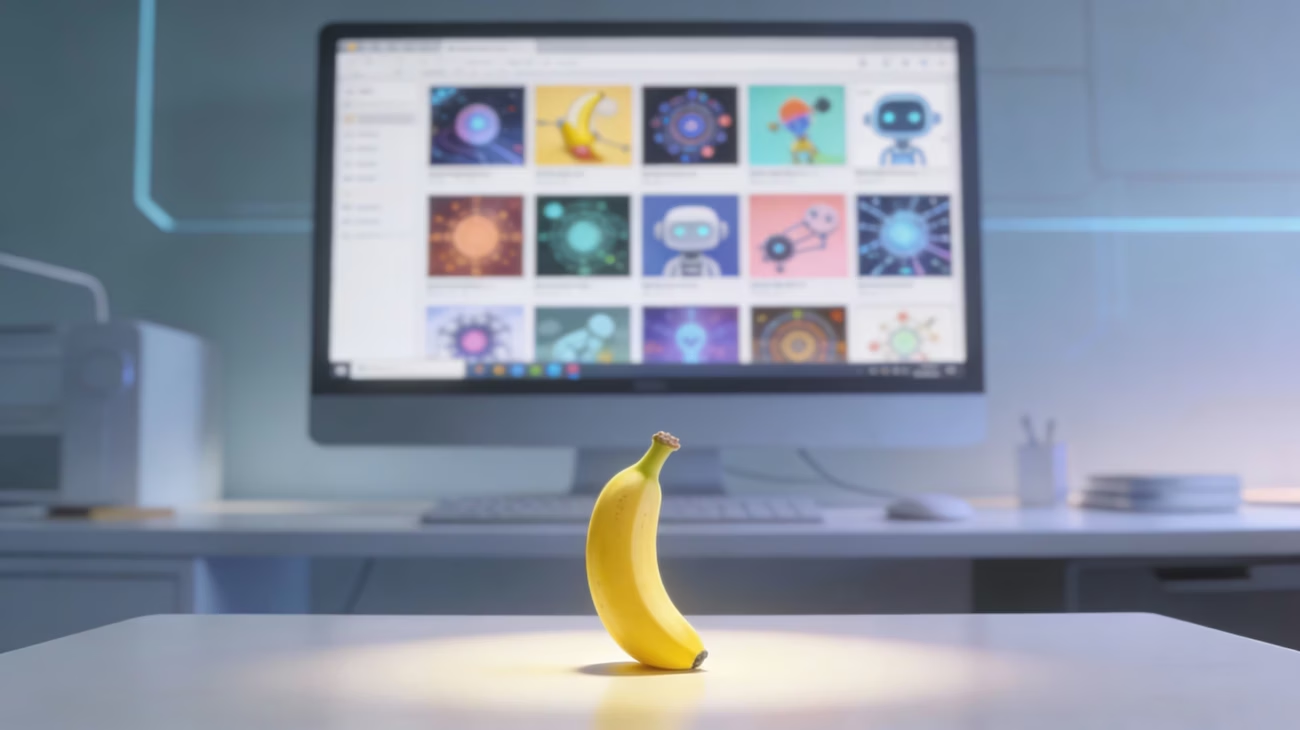
By a Creative Technologist
I remember the press release. We all do.
It was February 2025. The rumors were flying that Google was about to drop its answer to Sora, OpenAI’s hyper-realistic video model. We were expecting something corporate. Something heavy. Something named Gemini Ultra Vision Pro Max Enterprise Edition.
Instead, we got a 15-second teaser video of a raccoon breakdancing in a neon grocery store, set to a glitch-hop beat. The text on the screen didn’t say “State of the Art.” It didn’t say “AGI.”
It just said: “Nano Banana. Go make something weird.”
The tech press was confused. Wall Street was baffled (Alphabet stock dipped 2% that morning). But the internet? The internet went absolutely feral.
Ten months later, the war is over. OpenAI’s DALL-E and Sora are technically “superior” on benchmarks. They have better ray-tracing. They have fewer artifacts. And yet, nobody cares. If you open Twitter, Bluesky, or TikTok today, 90% of the AI-generated visuals you see are tagged #BananaGen.
Google didn’t win by building a better camera. They won by building a better hallucination machine. Here is how the most corporate company in Silicon Valley learned to stop worrying and love the meme.
1. The “Stock Photo” Trap: Why Perfection Became Boring
To understand the genius of Nano Banana, you have to look at where OpenAI went wrong.
OpenAI treated image generation like a science project. Their goal was Fidelity. They wanted to create a perfect mirror of reality.
If you asked DALL-E 4 for a “corporate meeting,” it gave you a flawless, high-resolution image of diverse professionals in a glass boardroom. The lighting was perfect. The shadows were ray-traced.
And it was utterly, painfully boring.
It had the “Netflix Gloss”—that shiny, digital sheen that makes everything look expensive but soulless. It was safe. It was sanitized. It was perfect for a PowerPoint presentation at a Fortune 500 company, but it was useless for a shitpost.
And let’s be honest: Shitposting drives culture.
Culture isn’t made by corporate marketing teams. It’s made by teenagers in basements making memes. It’s made by artists trying to break the tools. It’s made by “cursed images.”
OpenAI built a tool for the Boardroom. Google built a tool for the Group Chat.
2. The “Banana” Aesthetic: Embracing the Glitch
When Google released Nano Banana Pro, they made a baffling technical choice. They didn’t optimize for “Photorealism” as the default. They optimized for “Stylistic Variance.”
Technically, this means the model has a massive “Temperature” range and a training set heavily weighted toward internet art, comics, and surrealism.
If you prompt Nano Banana: “A dog eating a hotdog.”
DALL-E 4 gives you a Golden Retriever sitting politely on a patio with a hotdog on a plate.
Nano Banana gives you a dog wearing a hotdog suit, floating in zero gravity, eating a hotdog that is also screaming.
It was weird. It was colorful. It looked like an Adult Swim bumper from 2005.
Critics called it “broken.” They pointed out that the dog had six legs. They laughed at the physics glitches.
But the creators loved it.
Those “glitches” became a style. The “Banana Aesthetic”—saturated colors, slight fish-eye lens distortion, and surreal logic—became the visual language of 2025.
Google leaned into this. They didn’t patch the glitches; they turned them into features. They added a “Weirdness Slider” right in the UI.
0%: Stock Photo.
50%: Pixar Movie.
100%: Fever Dream.
OpenAI was trying to sell you a camera. Google sold you a kaleidoscope.
3. The “Uncanny Valley” vs. “The Vibe”
There is a concept in robotics called the Uncanny Valley.1 As a robot gets closer to looking human but isn’t quite there, it becomes terrifying (think The Polar Express).
OpenAI’s video model, Sora, lived in the Uncanny Valley. It was almost real, which made the tiny errors—the blinking eyes, the floating hands—deeply disturbing. Watching a Sora video felt like watching a skinwalker pretending to be a human.
Nano Banana bypassed the Uncanny Valley by taking a detour through Cartoon Town.
Because Nano Banana didn’t try to look “real,” its mistakes didn’t look scary; they looked funny.
When Nano Banana messes up a hand, it doesn’t look like a mangled claw; it looks like a cartoon glove. When it messes up physics, it looks like Looney Tunes logic.
This made the AI approachable. It wasn’t a “Simulation of Reality” (which implies surveillance and deepfakes). It was a “Toy.”
And people love toys.
4. The Branding Pivot: Friendly vs. God-Like
The name “Nano Banana” deserves its own case study.
For years, AI naming conventions were obsessed with size and power.
Titan.
Goliath.
Olympus.
Omni.
These names scream: “I am a God. Worship me. Fear me.”
Then comes Google with “Nano Banana.”
It sounds small. It sounds silly. It sounds harmless.
This was a psychological masterstroke.
In 2024, the public was terrified of AI. They were scared of deepfakes, scared of job loss, scared of Skynet.
You can’t be scared of a Banana.
By giving the model a cute, disarming name, Google lowered the “Fear Barrier.”
My mom uses Nano Banana to make birthday cards. She would never touch “Gemini Ultra.” The name sounded too sci-fi. But “Banana”? That sounds like an app on her iPad.
It’s the same strategy Snapchat used with “Spectacles” vs. Google Glass.
Google Glass looked like cyborg tech. It failed.
Snapchat Spectacles looked like a toy. They were fun.
Google finally learned its own lesson. If you want mass adoption, stop trying to look like the CIA and start trying to look like Fisher-Price.
5. The “Meme-Ability” of the Output
The ultimate currency of the internet is the Meme.
A meme is a unit of culture that spreads virally.2
To be a meme, an image needs to be:
Distinctive: You need to recognize it instantly.
Remixable: You need to be able to add text to it easily.
Expressive: It needs to convey a specific emotion (usually irony or absurdity).
Nano Banana natively understands “Meme Formats.”
You can actually prompt it: “Make this a reaction image for when you leave the stove on.”
It understands the visual grammar of a reaction image—the close-up face, the motion blur, the specific type of impact font.
OpenAI doesn’t allow this. Their “Safety Filters” block copyrighted meme formats. They block “low quality” text. They try to be high-art.
Google realized that “Low Quality” is actually “High Value.”
They trained Nano Banana on millions of Reddit threads and Discord servers. It knows what “Cursed” means. It knows what “Based” means.
It speaks the language of the internet native.
When the “Sad Hamster” trend took off last month, Nano Banana was the engine behind it. People used the model to generate millions of variations of that sad hamster.
OpenAI’s DALL-E refused to generate it because it flagged the hamster as “potential animal distress.”
Google let the hamster happen. And they won the cycle.
6. The “Prompt-Less” Revolution
Finally, Google fixed the interface.
Prompt Engineering is hard. Typing “A cinematic shot of a cyberpunk city, 8k, volumetric lighting, unreal engine 5” is annoying.
Nano Banana introduced “Vibe Prompts.”
Instead of typing words, you feed it other images.
You drag in a picture of a 90s anime, a picture of a brutalist building, and a picture of a cat.
You hit “Blend.”
The model extracts the “Vibe” (the aesthetic) from the anime, the “Structure” from the building, and the “Subject” from the cat.
It creates a Brutalist Anime Cat.
This “Visual Prompting” killed the need for complex text descriptions. It turned image generation into a DJ deck. You are mixing samples, not writing code.
It made everyone an artist, not just the people who memorized the dictionary of art styles.
Conclusion: The Victory of “Fun”
For a decade, Google was the “Boring” company. They were the company of blue links, spreadsheets, and killed messaging apps.
OpenAI was the cool startup.
But somewhere in 2025, the roles flipped.
OpenAI became the “Suit.” They got bogged down in enterprise contracts, safety boards, and government hearings. They became the IBM of AI.
Google, perhaps out of desperation, decided to let their hair down. They looked at their DeepMind research—some of the wildest, weirdest tech on earth—and said, “Stop trying to make it safe. Make it fun.”
Nano Banana is the result.
It’s not the most accurate model. If you need a diagram of a human heart for a medical textbook, use DALL-E.
But if you need a picture of a raccoon breakdancing in a grocery store to express how you feel about your job?
There is only one choice.
Google won the image war because they realized something fundamental about human nature that Silicon Valley often forgets:
We don’t just use technology to be productive. We use it to be entertained.
We didn’t want a God. We wanted a toy.
And the Banana is a hell of a toy.