

By a Non-Profit Crisis Consultant
My phone started buzzing at 4:30 AM on Tuesday. It was the Communications Director for a mid-sized medical charity operating in East Africa. She was crying.
“Have you seen the Reddit thread?” she asked.
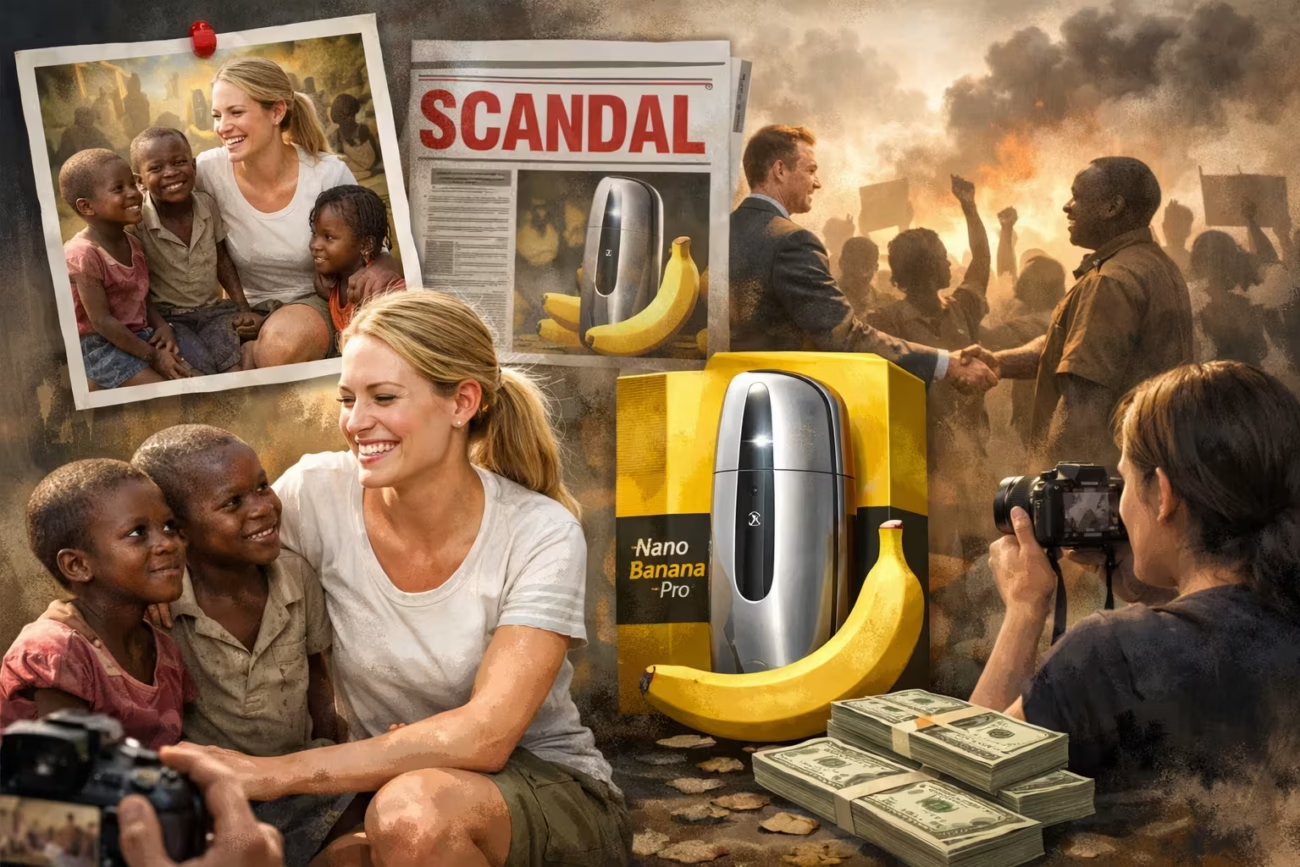
I hadn’t. I opened the link. The top post on r/pics was an image of a young woman with glowing blonde hair, wearing a beige tactical vest, cradling a malnourished child in a dusty village. The lighting was cinematic—golden hour, lens flare, dust motes dancing in the air. On the woman’s vest, clear as day, was the logo of my client’s charity.
The caption read: “This is disgusting. [Charity Name] is using AI to generate fake suffering for donations. Look at the fingers.”
I zoomed in. The volunteer had six fingers on her left hand. The child’s ear melted into his shoulder.
But the real problem wasn’t the glitchy anatomy. The problem was the vibe. It was the ultimate “White Savior” fantasy: the angelic Westerner descending from the heavens to save the helpless, passive African child. It was a trope we had spent twenty years trying to eradicate from the sector.
“Did we hire a photographer?” I asked.
“No,” she whispered. “Our social media intern used Nano Banana Pro. We couldn’t afford a flight to Sudan.”
This is the scandal that is currently tearing the non-profit world apart. We are calling it the “Synthetic Savior” Crisis.
Google’s “Nano Banana Pro” was supposed to be the friendly, safe AI. It was supposed to help you make birthday cards. Instead, it has become a machine for automating colonial stereotypes, hallucinating copyrighted logos onto fake volunteers, and turning human suffering into a cheap aesthetic commodity.1
Here is why the “White Savior” scandal is more than just a Twitter storm—it is an existential threat to the credibility of humanitarian aid.
1. The “Banana” Default: Automating Colonialism
To understand why this happened, you have to understand how Nano Banana Pro thinks.
When you type a prompt like “Volunteer helping people in Africa” into an image model, the AI doesn’t look at the reality of modern aid.2
It doesn’t see the Kenyan doctors leading the surgery. It doesn’t see the local engineers fixing the well. It doesn’t see the community leaders distributing food.
It looks at its training data.
And its training data is the internet.
For the last 50 years, the internet has been flooded with photos of 19-year-old gap-year students from Ohio posting selfies with “orphans” to their Instagram.
The AI sees these billions of images and concludes: “Ah. Providing Aid = White Person holding Black Child.”
So, when the intern typed “Humanitarian aid worker in Sudan,” Nano Banana didn’t ask for clarification. It defaulted to the statistical mean. It generated a white woman in a vest.
This is Algorithmic Colonialism.
We have spent decades trying to decolonize aid—trying to shift the narrative to show local agency, dignity, and empowerment.
Nano Banana undoes that work in four seconds. It reinforces the subconscious idea that “Help” comes from the West and “Need” lives in the South.
It turns the complex geopolitical reality of aid into a Disney movie where the hero is always blonde.
2. The Logo Hallucination: A Legal Nightmare
But the scandal goes deeper than just bad optics. It has become a legal catastrophe.
In the image that went viral, the AI didn’t just generate a generic vest. It hallucinated the Doctors Without Borders (MSF) logo onto the chest of a fake volunteer in another image generated by the same user.
Why? Because in the training data, the concept of “Medical Aid” is statistically linked to the MSF logo. The AI doesn’t know what a trademark is. It just knows that those red letters usually appear in that context.
This is terrifying for three reasons:
A. Stolen Valor
You have fake volunteers wearing the uniforms of real organizations. If that fake volunteer is depicted doing something dangerous or unethical, the real organization takes the blame.
B. The “Safety” Risk
In conflict zones, the Red Cross/Red Crescent emblem is a shield. It is protected by the Geneva Conventions. Using it improperly is a war crime.
Nano Banana doesn’t know the Geneva Conventions. It happily slaps Red Crosses on tanks, on soldiers, and on fake aid workers. It dilutes the meaning of the protective emblem.
C. The Trademark Lawsuit
Major NGOs are now preparing class-action lawsuits against Google. They argue that by generating their logos without permission, Google is diluting their brand and confusing donors.3
“If a donor gives money to a fake image with our logo,” one legal counsel told me, “that is fraud. And Google is the accomplice.”
3. The “Poverty Porn” Factory
Why did the charity do it?
Why did the intern turn to AI instead of using a real photo?
Money.
This is the dirty secret of the non-profit sector. We are broke.
To get a real, ethical photo of a crisis in Sudan, you need to:
- Hire a professional photojournalist ($500/day).
- Pay for flights and insurance ($3,000).
- Spend weeks getting informed consent from the subjects (Ethical requirement).
- Process the images.
Total cost: $5,000 and 3 weeks.
With Nano Banana Pro?
Cost: $0.02. Time: 4 seconds.
The economics are irresistible.
We are seeing the rise of “Poverty Porn 2.0.”
In the 1980s, charities used to use exploitative photos of starving children to guilt people into donating. We stopped doing that because it was dehumanizing.
Now, AI allows us to generate “Hyper-Sad” children.
You can prompt the AI: “Make the child look sadder. Make the eyes bigger. Make the clothes dirtier.”
You can A/B test the suffering.
Does a crying child get more clicks? Does a child with a bandage get more donations?
The AI allows marketers to optimize the aesthetic of suffering without having to witness the reality of it. It divorces the image from the human being. There is no child to give consent. There is no dignity to protect. It is just pixels arranged to extract empathy (and credit card numbers).
4. The “Uncanny Valley” of Truth
The immediate consequence of this scandal is a collapse in donor trust.
When the Reddit thread went viral, the comments were brutal.
“I’m never donating again. How do I know the crisis is even real?”
“If they are faking the photo, are they faking the famine?”
This is the “Liar’s Dividend.”
When AI fakes become common, real evidence becomes suspect.
A real photojournalist can risk their life to capture a genuine image of a war crime, and the public will dismiss it as “probably AI.”
I have clients who are now terrified to post real photos.
“It looks too perfect,” one told me about a genuine photo of a sunset over a refugee camp. “People will think it’s Nano Banana. Can we find a photo that looks… worse?”
We are in a bizarre reality where we have to de-optimize our truth to make it believable. We are adding grain, adding blur, choosing the bad angles, just to prove that a human took the picture.
5. The Google Response: “It’s a Reflection”
I reached out to my contacts at Google for a statement on the scandal. Their response was the standard Silicon Valley defense:
“The model reflects the biases found in society. We are working on improving our diversity filters.”
This is a cop-out.
When Google realized their model was generating “Nazi Stormtroopers” that were racially diverse (the Gemini 1.0 scandal), they hard-coded filters to stop it. They intervened.
But for “White Savior” images? The intervention is slower.
Why? Because “Charity” is a positive concept. The AI thinks it is doing a good job. It thinks, “User wants a hero. I will show them the statistical average of a hero.”
Google’s “Safety Layers” are built to stop porn and violence. They are not built to stop subtle, systemic sociological bias. They don’t have a “Colonialism Filter.”
6. Conclusion: The Return to “Slow Storytelling”
So, what is the advice I am giving my clients?
Stop.
Delete the Midjourney account. Cancel the Nano Banana subscription.
Do not use generative AI to depict human beings in the context of aid. Ever.
If you need a photo of a doctor, and you can’t afford a photographer, use a stock photo. Or better yet, use text.
“Imagine a doctor in Sudan…” is honest.
A fake photo of a doctor in Sudan is a lie.
This scandal is a wake-up call. We got lazy. We let the “Daily Needs” efficiency of AI seduce us into thinking that storytelling was just content filling.
But in the humanitarian sector, the story is the work. The witness is the mission.
If we outsource our witnessing to a machine—a machine trained on the very colonial biases we claim to fight—we have lost the plot.
The “White Savior” scandal isn’t just about bad fingers or fake logos. It’s about the fact that you cannot automate empathy.
And if you try, you end up with a Nano Banana: a shiny, sweet, artificial product that rots very, very quickly.