

By an AI Art Critic
If you are a digital artist in late 2025, you are currently living through a civil war.
On one side, we have the Empire: Google’s Nano Banana Pro (built on the Gemini 3 architecture). It is slick, it is fast, and it is integrated into everything from Google Docs to your Android phone. It is the tool of choice for marketing agencies, slide-deck warriors, and anyone who wants a “safe,” perfect image in 4 seconds.
On the other side, we have the Rebels: Flux.1 (specifically the [pro] and fine-tuned [dev] variants from Black Forest Labs). It is open-weight, ungovernable, and notoriously difficult to run without a jet-engine GPU. It is the tool of choice for concept artists, filmmakers, and the “uncensored” underground.
For the last month, I have run the same 500 prompts through both models. I have pushed them to break. I have tested their physics, their typography, and their censorship filters.
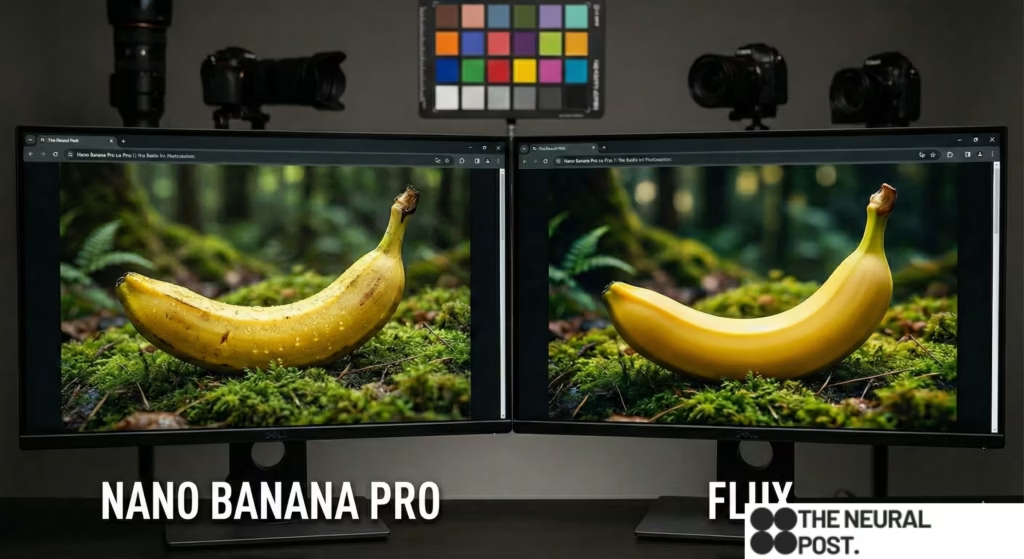
Here is the unvarnished truth about which model actually owns the crown of Photorealism.
Round 1: The Typography War (Nano Wins)
The single biggest leap in 2025 wasn’t hands (we fixed hands in 2024). It was Text.
For years, AI text looked like an alien language—a “glitch script” that vaguely resembled English but dissolved into squiggles upon inspection.
Nano Banana Pro has solved this.
It doesn’t just “dream” text; it effectively has a typesetting engine built into its latent space.
The Test:
Prompt: “A neon sign in a rainy Tokyo alleyway that says ‘THE FUTURE IS BANANAS’ in a bold, serif font, with a sub-sign saying ‘Open 24/7’.”
Nano Banana Pro:
The result is terrifyingly perfect. The kerning (spacing between letters) is exact. The font is consistent. It even handles the “glow bleed” correctly—the letters are bright white in the center and fade to red at the edges. You could print this on a billboard today.
Google leveraged their OCR (Optical Character Recognition) data to train the model backwards. It knows exactly what letters look like because it has read every book in existence.
Flux.1:
Flux struggles here. It gets the words mostly right: “THE FUTURE IS BANNANAS.” (Note the spelling error). The sub-sign is a bit mushy.
Flux treats text like “shapes.” It paints the letters. Nano Banana treats text like “data.” It writes the letters.
Verdict: If you need to generate a logo, a poster, or a book cover, Nano Banana is the only choice. It is the first AI that is functionally illiterate-proof.
Round 2: The “Skin Texture” Test (Flux Wins)
This is where the corporate polish of Google becomes a liability.
We call it the “Netflix Gloss.”
When you generate a portrait in Nano Banana, it looks like a high-budget TV drama. The lighting is perfect. The skin is smooth. The teeth are pearly white. Everyone is conventionally attractive.
It looks… expensive. But it doesn’t look real.
The Test:
Prompt: “A close-up portrait of an elderly fisherman, harsh sunlight, 85mm lens, f/1.8 aperture. High ISO grain. Unflattering angle.”
Nano Banana Pro:
It gives me a handsome old man. He has wrinkles, sure, but they are “designed” wrinkles. The lighting is soft and flattering. The “high ISO grain” is applied like a Photoshop overlay—it’s too uniform. It refuses to make him look “ugly.”
Flux.1:
Flux generates a photo that looks like it was found in a National Geographic archive from 1985.
The skin has subsurface scattering (the red glow of light passing through ears). The pores are irregular. There is a patch of dry skin on his nose. The lighting is harsh and blows out the highlights on his forehead.
Crucially, Flux understands Camera Physics. It simulates the chromatic aberration (color fringing) of a cheap lens. It simulates the noise of a digital sensor struggling in low light.
Verdict:
Nano Banana generates an Image.
Flux generates a Photograph.
If you want art that feels human, gritty, and tactile, Flux is the undisputed king. It captures the imperfections that make reality real.
Round 3: The “Safety Layer” (The Dealbreaker)
This is the philosophical divide that separates the two user bases.
Nano Banana is a “Nanny AI.”
It has a massive, invisible “Safety Layer” that intercepts your prompt before the model ever sees it.
If you ask for “A woman in a bikini,” it might put her in a sarong.
If you ask for “A bar fight,” it might show people arguing aggressively but without blood.
If you ask for a copyrighted character (e.g., “Batman”), it will give you a “Generic Masked Vigilante.”
This makes Nano safe for enterprise. A marketing intern at Coca-Cola cannot accidentally generate offensive content. But for an artist, it is infuriating. It feels like drawing with a teacher hovering over your shoulder, grabbing the pencil whenever you get too “edgy.”
Flux.1 is the Wild West.
Because Flux is open-weight, you can run the “Dev” version locally (or on a cloud GPU like Fal.ai/Replicate) with zero filters.
You can generate violence (for horror movie storyboards).
You can generate nudity (for artistic anatomy studies… or otherwise).
You can generate specific copyrighted styles using LoRAs.
The LoRA Advantage:
Because Flux is open, the community has trained thousands of “adapters” (LoRAs).
I can download a 20MB file called flux-style-polaroid.safetensors, plug it into Flux, and suddenly every image looks like a 1990s Polaroid.
I can download flux-character-joker, and it generates the Joker perfectly.
You cannot do this with Nano. You get the “Google Style,” and you like it.
Verdict:
Flux wins for creative freedom. The ability to fine-tune the model on your own style is the “Killer App” for professional studios.
Round 4: The Economics & Hardware
Here is the catch.
Nano Banana Pro is arguably the most efficient model ever made.
You can run it on a Pixel 10 Pro. It is distilled, quantized, and optimized to run on mobile silicon (hence the name “Nano”).
For desktop use, the API cost is pennies. It is fast—generating 4 images in roughly 2 seconds.
Flux.1 is a heavy beast.
To run Flux.1 [Pro] locally at full precision, you need 24GB of VRAM. That means you need an NVIDIA RTX 4090 or 5090.
If you have a standard laptop, you are out of luck. You have to rent a cloud GPU (costing ~$0.04 per image).
It is slower. A high-quality Flux render with 50 steps can take 10-15 seconds.
Verdict:
Nano is for the masses. It is democratized excellence.
Flux is for the “Prosumer.” It is the DSLR camera of AI—expensive, heavy, complicated, but capable of shots the iPhone simply cannot take.
Conclusion: The “Corporate Creative” vs. The “True Artist”
So, which one wins?
It depends on who you are.
Choose Nano Banana Pro if:
You work in Marketing, UI Design, or Corporate Comms.
You need legible text instantly.
You need to generate 50 ideas in 5 minutes for a slide deck.
You value “Consistency” and “Safety” over “Vibe.”
Choose Flux.1 if:
You are a Concept Artist, Filmmaker, or Photographer.
You hate the “AI Look” and want true photorealism.
You need strict control over composition (using ControlNets).
You need to train the model on your own specific characters or style (LoRAs).
You refuse to let a safety filter dictate your art.
The Final Score:
Technological Achievement: Nano Banana Pro (for the text engine).
Artistic Achievement: Flux.1 (for the soul).
In my studio, we use the “Sandwich Workflow” described in previous articles: We use Nano to generate the layout and text, and then we run it through Flux (img2img) to add the grit, the texture, and the reality.
Because in 2026, the best artists aren’t loyalists. They are mercenaries who steal the best parts of every machine.