

By a Tired Hiring Manager
I posted a job opening last week. The title was “Senior AI Engineer.”
In 24 hours, I received 1,400 applications.
In 2021, this would have been a goldmine. In 2025, it is a landfill.
I spent my Sunday morning clicking through resumes. It was a sea of sameness.
- “Certified Prompt Engineer.”
- “Built a PDF Chatbot using LangChain.”
- “Fine-tuned Llama 3 on a dataset of Shakespeare.”
Everyone had the same GitHub portfolio. Everyone had the same Coursera certificates. And everyone expected a salary of $200,000 because they read a Business Insider article saying AI is the new oil.
I rejected 1,398 of them.

Here is the dirty secret of the 2025 tech market: We don’t need “AI Engineers.”
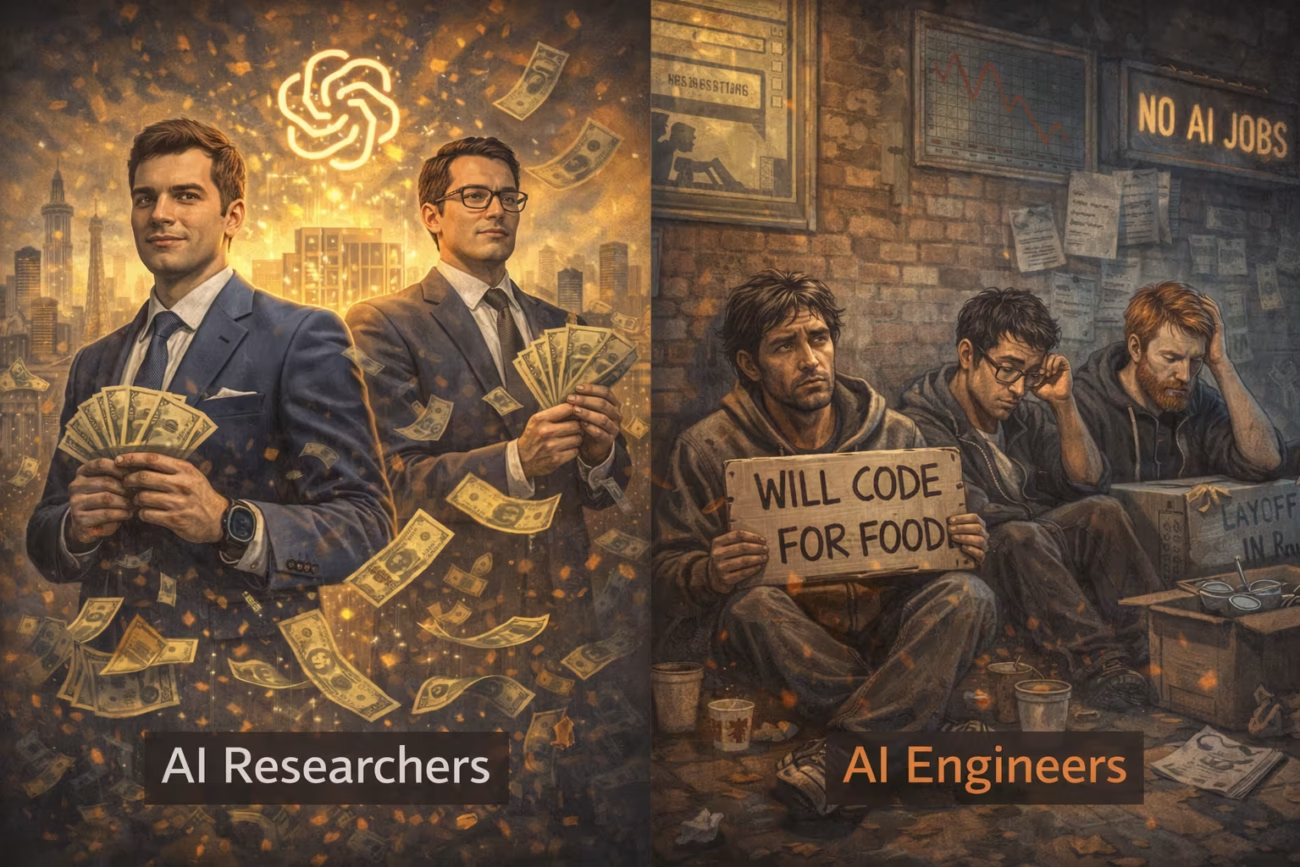
At least, not the kind that the bootcamps are churning out. The market has bifurcated into two extremes: the Gods and the Janitors. The Gods (Researchers) are buying islands. The Janitors (Systems Architects) are doing well.
But the “AI Engineer”—the person who just connects an API to a frontend? They are unemployed. Because that isn’t a job anymore. It’s a script that Cursor writes for me in four seconds.
We are in a talent crisis, but it’s not a shortage of people. It’s a shortage of utility. Here is why the “AI Engineer” bubble has burst, and what you actually need to learn to survive.
1. The Aristocracy: Why Researchers Are Paid Like NBA Stars
First, let’s talk about the people who are rich.
If you have a PhD in Mathematics from Stanford, and your name is on a paper about “Sparse Attention Mechanisms in Transformer Architectures,” you can basically walk into Meta or Google and demand a signing bonus equal to the GDP of a small island nation.
These are the AI Researchers.
There are maybe 500 people on planet Earth who truly understand how these models learn. They aren’t just using the tools; they are building the tools. They are the ones figuring out how to make GPT-6 reason without hallucinating, or how to train a model on 10% of the data with 90% of the performance.
Companies pay them millions not because they produce immediate revenue, but because they are the Nuclear Deterrent.
- Meta needs them so Google doesn’t win.
- Google needs them so OpenAI doesn’t win.
- The UAE needs them so they don’t have to rely on the US.
This is an arms race. And like the Manhattan Project, if you are a nuclear physicist, life is good.
But for 99.9% of us? We are not researchers. We are not going to invent the next Transformer. And trying to compete in this bracket is suicide unless you are willing to spend 8 years in academia.
2. The “Wrapper” Engineer: The Unemployable Middle
This brings us to the “AI Engineer”—the title that exploded in 2023.
The definition of an AI Engineer for the last two years was: “Someone who knows how to use the OpenAI API and maybe a vector database like Pinecone.”
It was a glorious time. You could watch a 3-hour YouTube tutorial, build a “wrapper” app (like “Chat with your PDF”), and get hired for $150k.
That era is dead.
Why? Because AI writes that code now.
I don’t need to hire a junior engineer to write a Python script that calls client.chat.completions.create.
I just open my IDE (Windsurf or Cursor), type “Build me a RAG pipeline that connects to Pinecone and uses GPT-4o,” and the AI writes the entire codebase, sets up the environment variables, and writes the README in about 45 seconds.
The “Wrapper Engineer” has been automated by the very technology they were trying to master.
This is why my inbox is full of unemployed boot-campers. They learned a skill—API Glue Code—that had a shelf life of exactly 18 months. They are the “Webmasters” of 2025. In 1998, knowing HTML was a career. By 2005, it was a baseline skill for a 12-year-old.
Prompt Engineering? Dead.
Basic RAG implementation? Automated.
Fine-tuning a model via a UI? A commodity.
3. The Real Crisis: Deployment is Hell
So, who am I hiring?
I am not looking for someone to build the model. I am looking for someone to tame it.
I call this the “Deployment Gap.”
It is incredibly easy to get a demo working in a Jupyter Notebook. It is incredibly hard to get that demo running in production at scale without bankrupting the company.
Here are the problems I actually face every day:
A. The Latency War
My CEO wants the chatbot to answer in 200 milliseconds. GPT-4 takes 3 seconds.
I need an engineer who understands Quantization. Who knows how to take a 70B parameter model, compress it to 4-bit, run it on a specific NVIDIA A10G instance using vLLM, and manage the KV-cache paging to squeeze out every millisecond of performance.
- Resume Keyword: “vLLM,” “TensorRT,” “CUDA optimization.”
- Resume I get: “I know how to prompt Claude.”
B. The Cost Crisis
We are burning $50,000 a month on API fees.
I need an engineer who can build a Router. Someone who can architect a system that uses a tiny, cheap model (like Llama 3 8B) for 90% of the queries and only calls the expensive GPT-5 API for the hardest 10%.
I need someone who can fine-tune a small model to outperform a big model on our specific data.
- Resume Keyword: “Distillation,” “Fine-tuning cost analysis,” “Serverless GPU orchestration.”
- Resume I get: “I built a cool demo.”
C. The Reliability Nightmare
The AI hallucinated and promised a customer a 90% discount.
I need an engineer who understands Evaluation Frameworks. Someone who builds automated test suites (using tools like DeepEval or Ragas) that constantly attack the model to see if it lies. I need “Guardrails” that sit between the AI and the user, parsing the output and blocking anything dangerous before it leaves the server.
- Resume Keyword: “Adversarial testing,” “Guardrails AI,” “Deterministic constraints.”
- Resume I get: “I am an prompt whisperer.”
4. The Rise of the “AI Plumber”
The job title of the future isn’t “AI Engineer.” It’s “AI Systems Architect.”
We need Plumbers.
We need Mechanics.
We need people who treat AI models not as magical brains, but as unreliable software components.
Think of an LLM like a really powerful, really unstable engine.
- The Researcher designs the engine. (Rich).
- The AI Engineer (old definition) knows how to turn the key. (Unemployed).
- The AI Mechanic knows how to build the transmission, the cooling system, and the brakes so the car doesn’t explode at 100mph. (Hired).
The Mechanic knows Linux. They know Docker. They know networking. They understand that “AI” is just a heavy compute workload that needs to be managed like a database.
5. What You Should Actually Learn (To Get Hired)
If you are a junior developer reading this and panicking, stop. You don’t need a PhD. But you do need to pivot.
Stop learning “How to use AI.” Start learning “How to serve AI.”
Step 1: Learn the “Boring” Stuff
Learn Docker. Learn Kubernetes. Learn Terraform.
The hardest part of running a local LLM isn’t the AI; it’s the dependency hell of CUDA drivers and Python versions. If you can be the person who says, “I can deploy this model to a Kubernetes cluster and ensure it auto-scales when traffic spikes,” you are hired instantly.
Step 2: Master “Small” AI
Stop obsessing over GPT-6. Master Llama 3, Mistral, and Phi.
Learn how to run them locally on your laptop using Ollama. Then learn how to strip them down. Learn how to quantize them. Learn how to finetune them using LoRA (Low-Rank Adaptation) on a cheap GPU.
Companies want to own their tech. If you can give them a private, cheap model that works good enough, you are more valuable than the guy who just rents OpenAI.
Step 3: Build “Evals,” Not Demos
Don’t show me a chatbot that works when I ask “Hello.”
Show me a GitHub repo with a test suite. Show me a graph that says: “My retrieval system has 84% accuracy on this dataset, and here is how I measured it.”
Show me that you understand Data Science rigor. Anyone can make a demo work once. Engineers make it work every time.
6. Conclusion: The End of the “Hello World” Era
The gold rush is over. The shovel sellers have left town.
We are now in the industrialization phase of AI. It’s messy. It’s hard. It’s about unit economics, reliability, and safety.
The “Talent Crisis” is real, but it’s a crisis of mismatch. We have too many dreamers and not enough builders. We have too many people who want to talk to the robot, and not enough people who know how to fix the robot when it breaks.
If you want a job in 2026, take “AI Enthusiast” off your LinkedIn.
Put “AI Reliability Engineer” on it.
And then go learn how to fix a broken CUDA driver.
Because while the Researchers are popping champagne on their yachts, the rest of us have a lot of plumbing to do.