

By a Tired Systems Architect
I had a screaming match with a Project Manager last week.
We were building a new internal tool for our marketing team—a “Campaign Generator” that could take a boring product brief and spin up wild, creative ad copy, while simultaneously checking the claims against our legal compliance database.
The PM insisted we use GPT-5.
“It’s the best model,” he said. “It does everything. It’s multimodal. It’s safe. It’s the industry standard.”
I tried to explain that using GPT-5 for this was like trying to use a spork to perform open-heart surgery. Sure, it’s a “do-it-all” tool. But it’s going to give you mediocre ad copy because it’s too afraid to be weird, and it’s going to give you risky legal advice because it’s too eager to please.
“We don’t need one model,” I told him. “We need two. We need a Liar and a Pedant.”
The industry is obsessed with the “One Model Fallacy.” We are chasing the dream of a single, monolithic AGI that is perfectly creative and perfectly accurate. We want a god-machine that can write poetry like Keats and debug C++ like Torvalds.
But in late 2025, the secret to building great software isn’t finding the perfect model. It’s realizing that Creativity and Accuracy are opposing forces. You cannot optimize for both in the same neural network without compromising one.
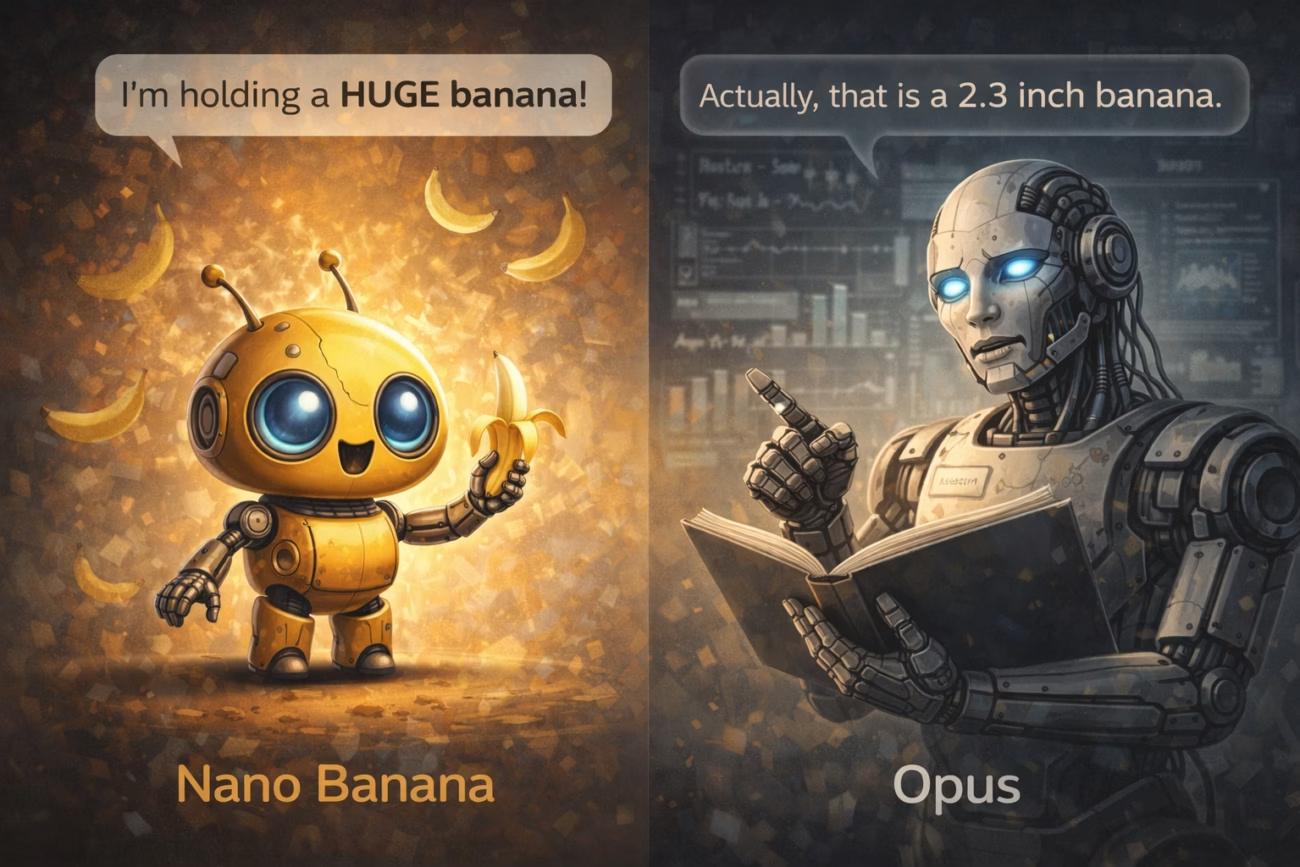
Here is why I stopped looking for a God-AI, and why my stack is now built on a “Team of Rivals”: a Liar (like Nano Banana) for the sparks, and a Pedant (like DeepSeek or Opus) for the safety rails.
1. The Physics of the “Omni” Trap
To understand why the “One Model” approach fails, you have to look at the math.
An LLM is a probability engine.1 It predicts the next token.
To make a model Creative, you want a “flat” probability distribution. You want it to consider the weird words, the unlikely connections, the “hallucinations.” You want High Temperature. You want it to drift off the road.
To make a model Accurate, you want a “spiky” probability distribution. You want it to pick the single most likely fact. You want it to stay strictly in the lane of the training data. You want Low Temperature.
When companies like OpenAI or Google build “Omni” models (GPT-5, Gemini Ultra), they try to smash these two behaviors together using RLHF (Reinforcement Learning from Human Feedback). They train the model to be “Helpful but Harmless.”
The result is the “Corporate Median.”
- Ask GPT-5 to write a surrealist story, and it gives you a generic “Alice in Wonderland” rip-off. It’s too “safe” to be truly weird.
- Ask GPT-5 to check a legal citation, and it might hallucinate a case because it’s still trying to be “creative” and helpful.
It is a B+ artist and a B+ lawyer.
If you are building a serious application, B+ isn’t good enough. You need the A+ artist (who lies constantly) and the A+ lawyer (who has zero imagination).
2. Meet the Liar: The Case for Nano Banana Pro
In my stack, the “Liar” is Nano Banana Pro (or sometimes Flux.1 for pure visuals).
I call it a “Liar” with affection. I want it to lie.
When I am brainstorming a marketing campaign, I don’t want facts. I want Lateral Thinking. I want the model to connect “Accounting Software” with “Deep Sea Fishing.”
Nano Banana Pro (Google’s surprisingly weird creative model) is perfect for this because it has a loose grip on reality. It is optimized for “World Simulation” and visual coherence, not factual strictness.
The Workflow:
I asked Nano Banana: “Invent a color that doesn’t exist and describe the taste of it.”
- The Pedant (Claude Opus) would say: “Colors are wavelengths of light; they cannot be invented, and they do not have a taste.” (Boring. Correct, but useless).
- The Liar (Nano Banana) said: “Glimmer-Rot. It looks like the static on an old TV but purple. It tastes like licking a 9-volt battery wrapped in velvet.”
That is a lie. But it is a useful lie. It sparked an idea for a visual identity.
If you sanitize your model to remove hallucinations, you kill Glimmer-Rot. You kill the spark. You need a model that is allowed to be wrong so that it can be interesting.
3. Meet the Pedant: The Case for DeepSeek & Opus
On the other side of the router sits the “Pedant.”
Currently, my Pedant of choice is DeepSeek-V3 (or Claude Opus 4.5 if I have the budget).
These models are the buzzkills of the AI world. They are trained on massive amounts of code, math, and legal text. They have been fine-tuned to say “I don’t know” rather than guess. They are rigid, literal, and annoying.
And they are essential.
The Workflow:
I took the “Glimmer-Rot” concept from the Liar and fed it to the Pedant.
Prompt: “We are running a campaign using the phrase ‘Licking a 9-volt battery.’ Check this against US safety advertising standards for children’s toys.”
DeepSeek didn’t try to be creative. It didn’t try to riff on the battery metaphor. It searched its internal database of CPSC (Consumer Product Safety Commission) regulations and output:
“WARNING: Associating ‘licking batteries’ with a product could violate CPSC guidelines regarding imitative behavior in minors. Recommend removing the specific action ‘licking’.”
It saved us from a lawsuit.
If I had asked the Liar to do this compliance check, it would have said: “That sounds like a shocking good time! Go for it!”
The Pedant is the editor. It is the compiler. It is the grown-up in the room.
4. The “Router” Architecture: How to Build the Team
So, how do you actually implement this? You don’t use the ChatGPT web interface. You use an LLM Router.
We use a simple architecture:
- The User Prompt comes in.
- The Classifier (A tiny, cheap model) analyzes the intent.
- Is the user asking for ideas, images, stories, or jokes? -> Route to The Liar.
- Is the user asking for code, facts, dates, or math? -> Route to The Pedant.
- The Synthesis (Optional): Sometimes, we chain them.
The “Writer’s Room” Pattern:
This is my favorite workflow for content generation.
- Step 1 (The Liar): “Generate 10 wild, high-risk ideas for a viral video about a toaster.”
- Output: A toaster that travels back in time to kill Hitler. A toaster that falls in love with a bathtub.
- Step 2 (The Pedant): “Review these 10 ideas. Flag any that violate brand safety guidelines or physics. Select the most feasible one.”
- Output: “Time travel is controversial. Bathtub romance implies suicide risk. Recommend Idea #4: A toaster that launches bread into space. This is physically impossible but brand-safe.”
- Step 3 (The Liar): “Write the script for Idea #4.”
By splitting the brain, you get the best of both worlds. You get the wild creativity of the hallucination engine, filtered through the rigid logic of the reasoning engine.
5. Why the “God Model” is a Trap for Startups
I see so many startups burning their runway trying to fine-tune Llama 3 to do everything.
They take a great coding model and feed it poetry to make it “more conversational.”
They take a great creative model and feed it SQL databases to make it “smarter.”
They end up with a Frankenstein Model.
It creates SQL queries that rhyme (syntax error).
It writes poems that look like JSON (soul error).
Specialization is the future.
Look at the human workforce. We don’t hire one person to be the Head of Legal and the Head of Graphic Design. Those are different brains. They require different temperaments.
Why do we expect a bag of matrices to be different?
The companies that win in 2026 will be the ones that embrace Model Diversity.
- They will use Flux for their UI generation.
- They will use DeepSeek Coder for their backend logic.
- They will use Gemini Flash for their high-speed customer chat.
They will treat models like Microservices, not like Oracles.
6. The Psychological Comfort of the “Pedant”
There is a final, psychological reason to use a dedicated Pedant model. Trust.
When I use Claude Opus, I know it’s a Pedant. I know it’s annoying. I know it will refuse to answer if the prompt is slightly ambiguous.
But because I know it’s a Pedant, I trust its “Yes.”
If Claude Opus says, “This code is bug-free,” I believe it, because I know it loves to complain.
If GPT-5 says, “This code is bug-free,” I don’t believe it, because I know GPT-5 wants me to be happy. It’s a people-pleaser.
In the “Team of Rivals,” the friction between the models is the feature. You want the Pedant to shoot down the Liar’s bad ideas. You want the Liar to mock the Pedant’s lack of vision.
The tension between Hallucination and Logic is what human intelligence is made of. We have a dream, and then we check if it’s possible.
We didn’t evolve one single brain mode to do both. We dream at night (Hallucination). We hunt during the day (Logic).
Stop trying to force your AI to daydream while it hunts. Let the Liar lie. Let the Pedant nag. And build a system that listens to both.