

By a Recovering SaaS Founder
I remember the exact moment my startup died. It wasn’t because we ran out of money. It wasn’t because our servers crashed. It wasn’t even because a competitor stole our customers.
It was a Tuesday morning in late 2025. I was watching the OpenAI livestream, sipping lukewarm coffee, feeling pretty good about our Q3 numbers. We had built a solid business: a tool that let marketing teams upload massive PDF reports and “chat” with them to extract insights. We had $2M in ARR (Annual Recurring Revenue). We had a cute logo. We had a roadmap.
Then, Sam Altman walked onto the stage.
He didn’t scream. He didn’t use pyrotechnics. He just casually announced “Deep Documents”—a native feature inside ChatGPT that could ingest 500 files at once, visualize the data, and write reports. It was faster than our tool. It was smarter than our tool.
And most importantly, it was free for anyone with a $20 subscription.
In the span of thirty seconds, my entire company turned into a “feature.” My value proposition evaporated. My $2M ARR wasn’t a business anymore; it was just an inefficiency in the market that OpenAI had finally corrected.
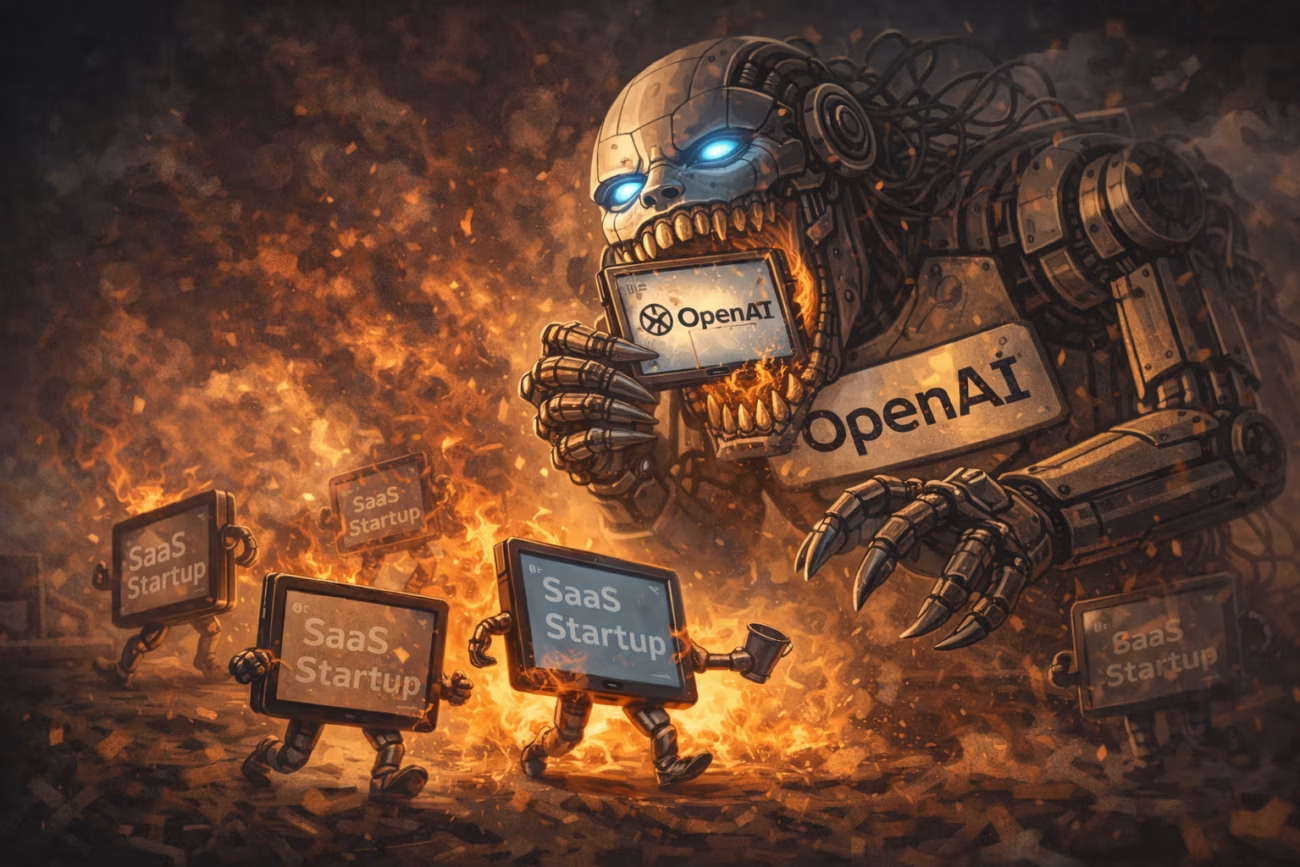
I am not alone. Across Silicon Valley, London, and Bangalore, there is a massacre happening. The era of the “Wrapper” startup—companies that simply put a nice user interface on top of someone else’s API—is officially over.
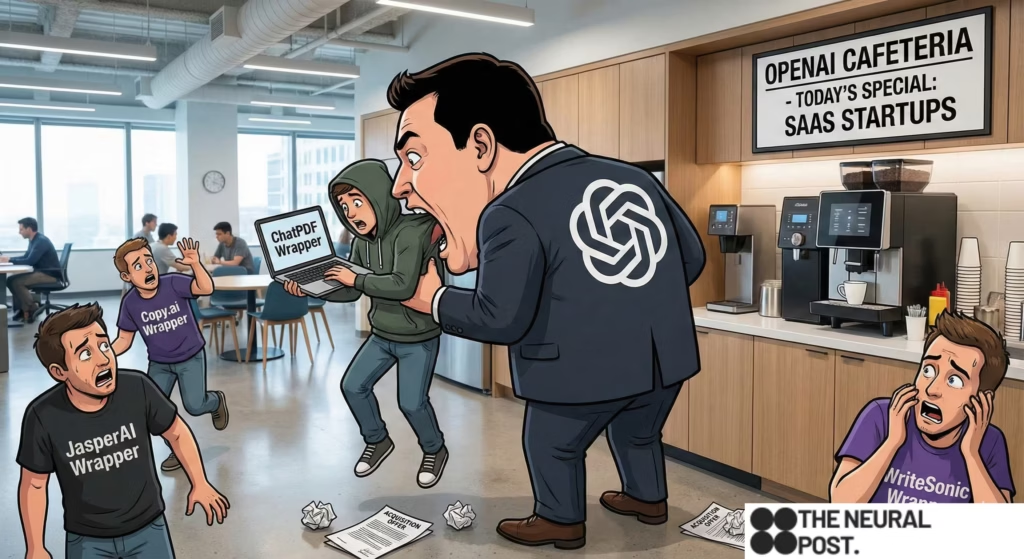
We are witnessing the “Sherlocking” of an entire industry. And if you are building software in 2026, you need to understand why the platform is eating the product.
1. The Anatomy of the “Wrapper” Gold Rush
To understand the crash, you have to remember the boom.
In 2023 and 2024, we lived through the “Golden Age of Wrappers.” The premise was seductive and simple: OpenAI’s models (GPT-3.5 and GPT-4) were brilliant, but their interface was a blank chat box. It was intimidating. It was messy.
Entrepreneurs saw a gap.
- “ChatGPT can’t read PDFs well? I’ll build ChatPDF.”
- “ChatGPT can’t write SEO blogs? I’ll build Jasper.”
- “ChatGPT can’t help me code in my IDE? I’ll build Copilot.”
These companies weren’t building AI. They were building UI. They were building the “Last Mile” of connectivity between the raw intelligence of the model and the specific needs of the user.
Investors loved it. It was low effort, high reward. You didn’t need a PhD in machine learning; you just needed a credit card for the OpenAI API and a React developer. We called it “Prompt Engineering as a Service.”
We convinced ourselves that we had a “Moat.” We told VCs: “Our prompt chain is proprietary! Our UX is sticky! We have first-mover advantage!”
We were lying to ourselves. We didn’t have a moat. We had a toll booth on a road someone else owned. And the owner of the road just decided to tear down the booth.
2. The Great Consolidation: Features vs. Products
There is an old brutal saying in tech, famously uttered by Steve Jobs when Dropbox tried to sell to Apple: “You’re a feature, not a product.”
In 2025, OpenAI (and Google/Anthropic) decided that everything is a feature.
Look at the graveyard of startups that have been “subsumed” into the foundational models over the last 12 months:
The “Research Assistant” Startups
Status: Dead.
Killer: OpenAI Deep Research / Perplexity.
The autopsy: Thousands of startups promised to “browse the web and summarize news.” Then OpenAI integrated real-time browsing that actually works. Why pay $30/month for a research tool when ChatGPT does it natively?
The “PDF Chat” Startups
Status: Dead.
Killer: The Context Window.
The autopsy: We used to rely on complex “Vector Databases” (RAG) to chop up documents because the models could only remember 8,000 words. Now? Gemini has a 2-million token window. You don’t need a startup to chop up the book; you just feed the entire book into the prompt. The technical problem we solved simply ceased to exist.
The “Voice Note” Startups
Status: Dying.
Killer: Advanced Voice Mode.
The autopsy: Remember apps that recorded your meetings and summarized them? ChatGPT now listens in real-time with human-level intonation. It doesn’t just transcribe; it participates. The standalone “Transcription App” is now just a button on the interface.
The platform logic is ruthless. If a use case is popular (like coding or writing), the model provider has a massive incentive to build it in-house. They have zero customer acquisition costs. They just push an update, and suddenly 200 million users have the feature you spent two years building.
3. The Economic Trap: The “Bundle” always Wins
The death of the Wrapper isn’t just about technology; it’s about wallet share.
In 2024, a power user might have had:
- $20/mo for ChatGPT.
- $30/mo for a Coding Assistant.
- $15/mo for a PDF tool.
- $20/mo for an Image Generator (Midjourney).
That’s $85/mo.
In 2026, the “Omni-Model Subscription” offers all of this for $30.
- GPT-5 writes the code.
- Nano Banana makes the images.
- Deep Documents handles the PDFs.
As a consumer, why would I manage five different logins and five different bills when one bill covers 90% of my needs?
This is the Microsoft Office strategy. Excel might not be the best spreadsheet, and Teams might not be the best chat app, but they are “free” with the bundle. Startups can’t compete with “free.”
I tried to fight this. I lowered my prices. I added features. But I was paying OpenAI for the API tokens to run my service. Essentially, I was buying raw materials from my biggest competitor, marking them up, and trying to sell them back to customers who could just buy direct from the factory. The economics were impossible.
4. The Illusion of the “Data Moat”
When we realized the UI wasn’t a moat, we pivoted to the new buzzword: “Data Moat.”
“We have the user’s data!” we screamed. “OpenAI doesn’t have their private documents!”
This was true for about six months. Then came the “Enterprise Connectors.”
OpenAI and Microsoft launched native integrations with Google Drive, OneDrive, Notion, and Slack.
Now, ChatGPT can see my files directly. It doesn’t need me to upload them to a third-party wrapper. It has permissioned access to my corporate brain.
The “Data Moat” turned out to be a puddle. Unless you own unique, proprietary data that exists nowhere else (like proprietary biological assay results or proprietary legal case files), you don’t have a data moat. If your data is just “The user’s own files,” the platform will eventually connect to them better than you can.
5. Survival of the Fittest: Vertical vs. Horizontal
So, is SaaS dead? Are we all going to work for Sam Altman?
No. But the “Middle Class” of SaaS is gone. The lazy startups are dead. To survive in 2026, you have to go where the giants cannot follow.
You have to go Vertical.
OpenAI is building a Horizontal tool. ChatGPT is a generalist. It knows a little bit about everything. It is a mile wide and an inch deep.
The surviving startups are going a mile deep.
Example 1: Harvey (Legal)
They didn’t just build “ChatGPT for Lawyers.” They built a tool that integrates with the specific, archaic court filing systems of 50 states. They tuned the model on proprietary case law that isn’t on the public web. They built features for “conflict of interest checking” that OpenAI would never build because it’s too niche. They are safe (for now).
Example 2: Sierra (Customer Support)
They didn’t just build a chatbot. They built an “Action Engine” that can actually log into a company’s Shopify backend and process a refund. OpenAI can talk about a refund; Sierra can execute it.
The Lesson: If your product output is Text, you are dead. If your product output is Action, you might survive.
The value isn’t in generating the email; the value is in sending it, tracking it, and updating the CRM. The “Wrapper” is dead; the “Agent” is the new king.
6. The “Services” Pivot
There is another path I see many founders taking (myself included): Admit you are a Consultancy.
Many “AI Startups” are realizing they aren’t software companies. They are service companies.
They are selling the implementation. They are selling the integration. They are selling the trust.
A massive law firm could use ChatGPT directly. But they won’t. They are terrified of it. They want a vendor to come in, set it up, sign a liability waiver, and promise to fix it if it breaks.
The software is a commodity; the Hand-Holding is the premium product.
We are seeing a pivot from “SaaS” (Software as a Service) to “SWaS” (Service With a Software). The margins are lower. It’s harder to scale. But it’s defensible because OpenAI doesn’t want to pick up the phone and talk to a angry CIO at 2 AM. I do. That’s my new moat: Pain Tolerance.
7. Conclusion: The Landlord is Moving In
The last three years were a hallucination. We thought we were pioneers settling a new frontier. We built little houses on the prairie.
We forgot that we didn’t own the land. We were squatting on OpenAI’s property. And now, the landlord has arrived, and he wants to build a skyscraper where our house stands.
If you are a founder today, look at your roadmap.
If your next feature is “Add a button to summarize text,” stop. OpenAI will do that next week.
If your next feature is “Let users chat with their data,” stop. Google just did that.
You need to build something that requires:
- Proprietary Data (that you generated, not scraped).
- Real-World Integrations (hardware, banking rails, legacy systems).
- Human Liability (taking the blame when things go wrong).
The era of the “Thin Wrapper” was a fun party. We made some money. We felt smart. But the lights are on, the music has stopped, and the cleanup crew is here.
It’s time to stop wrapping the gift and start making the actual product inside the box. Or, you know, just buy some NVIDIA stock and go to the beach. That seems to be the only winning move left.