

By a Digital Ref
I had a moment last week that stopped me cold.
I was searching for a solution to a specific error message on my dishwasher. It’s an old model, and usually, there’s a forum thread somewhere from 2014 where a guy named “FixItDave” explains exactly which capacitor to replace.
I clicked the first result. It was a 2,000-word article titled “Ultimate Guide to Fixing Error E4 on Bosch Series 8.”
The introduction was a flowery paragraph about the importance of clean dishes in modern society. Then, a section on the history of dishwashers. Then, a list of tools I might need (all Amazon affiliate links). Finally, I got to the solution.
It said: “To fix Error E4, simply ensure the device is plugged in. If the error persists, consider replacing the motherboard or buying a new unit.”
It was useless. It was vague. And it was clearly written by a Large Language Model (LLM) that had read the manual but had never held a screwdriver.
I clicked the second result. It was the exact same article, just rephrased. The third result was a YouTube video with an AI voiceover reading the same script over stock footage of a kitchen.
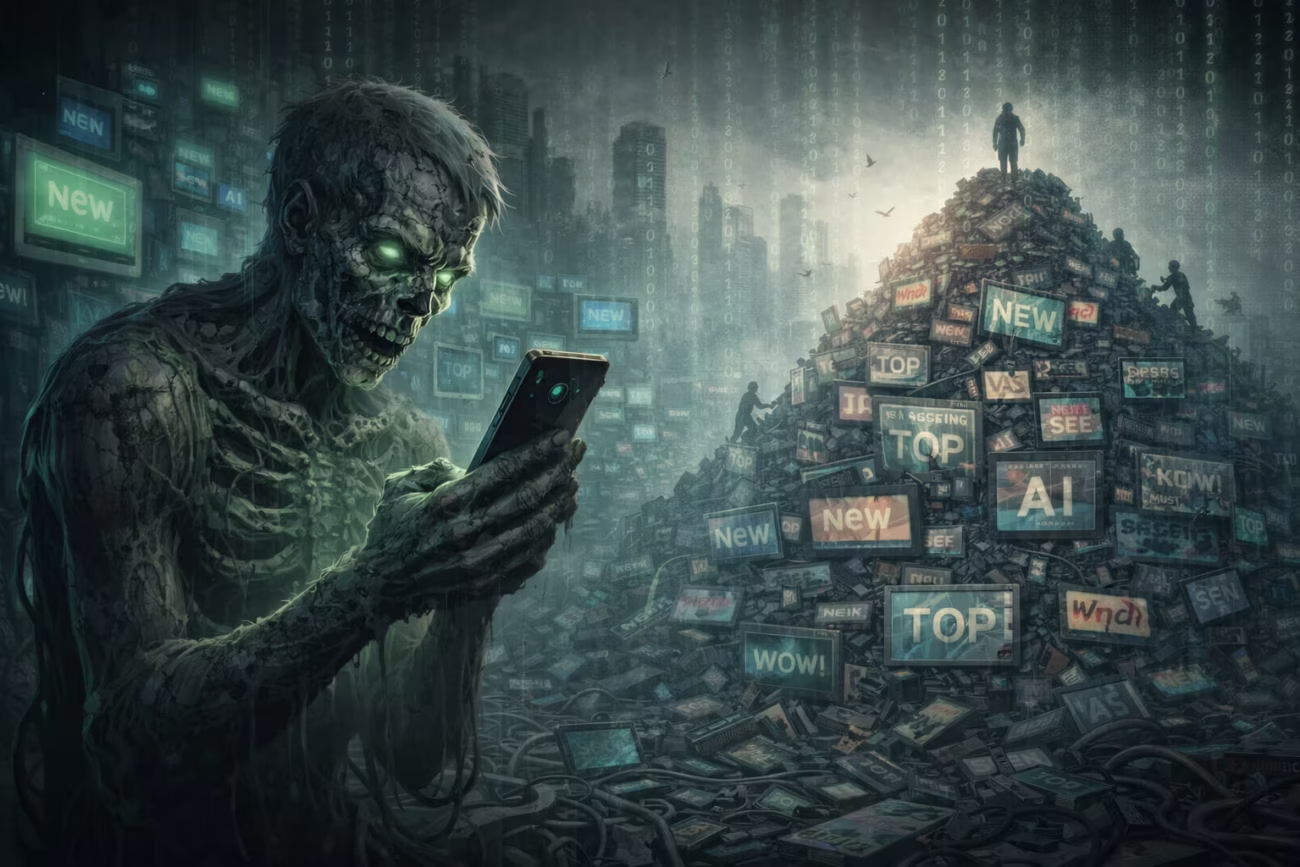
I sat there, staring at my broken dishwasher, and realized that the conspiracy theorists were right. The Dead Internet Theory isn’t a theory anymore. It is our reality.
We used to worry that the internet would be taken over by government surveillance or corporate paywalls. We were wrong. The internet wasn’t conquered; it was drowned. It has been buried under a tsunami of “Slop”—low-effort, AI-generated content designed to game algorithms rather than help humans.
Here is the autopsy of the World Wide Web, and why we might never get the old internet back.
Phase 1: The Zero-Marginal-Cost Content
To understand why the web feels “dead,” you have to look at the economics of typing.
For thirty years, creating content cost time. Even a spammer had to sit down and write the spam. A content farm had to hire underpaid writers to churn out SEO bait. There was a human bottleneck. That bottleneck meant that even the worst content had a tiny spark of human intent behind it.
Then came GPT-4, Llama, and Claude.
Suddenly, the cost of generating a 1,000-word article dropped from $50 (for a cheap writer) to $0.0004 (for an API call).
Capitalism hates a vacuum. When the cost of production hits zero, supply hits infinity.
We are now living in the era of Infinite Slop.
Marketing agencies have replaced copywriters with automated Python scripts that generate 5,000 blog posts a day. They target every possible long-tail keyword combination.
- “Best hiking boots for flat feet in Vermont.”
- “How to clean a cast iron skillet with oat milk.”
- “Is it safe to give my dog Tylenol?”
The AI generates the answer. It doesn’t know if the answer is true. It doesn’t care. It just wants to rank on Google. And because Google’s algorithm was built for a world where content was scarce, it is completely overwhelmed.
The result is “Grey Goo.” You search for information, and you get a hallucination wrapped in SEO keywords. The “human” element—the person who actually hiked in Vermont or cleaned the skillet—is buried on page 10.
Phase 2: The Social Zombie Apocalypse
If Search is dead, surely Social Media is still alive? That’s where the humans hang out, right?
Go look at the comments section under any viral post on X (formerly Twitter) or LinkedIn.
On LinkedIn, it is particularly dystopian. A “Thought Leader” posts a generic platitude about leadership.
“True leaders eat last.”
Look at the comments.
“Great insights! Totally agree that leadership is about service.”
“Thanks for sharing! This resonates with my experience.”
“Vital perspective for the modern ecosystem.”
These aren’t people. They are “Engagement Agents.” They are AI bots set up by sales professionals to auto-comment on thousands of posts a day to boost their profile visibility.
We have built a system where Bots talk to Bots.
One AI writes the post (using ChatGPT). Another AI comments on the post (using an automation tool). A third AI (the platform algorithm) sees the engagement and boosts the post to more users.
It is a closed loop of artificial engagement. The humans are just spectators, scrolling past a conversation that isn’t actually happening.
I recently saw a thread on X where two bots got stuck in a loop. One was a “Support Bot” apologizing for an error; the other was a “Complaint Bot” designed to complain about service. They argued back and forth for 40 replies until a human finally stepped in and blocked them both.
This is the “Dead Internet.” It looks active. The numbers are going up. But there is nobody home.
Phase 3: The Ouroboros Effect (AI Eating Itself)
The most terrifying part of this slop explosion is what it does to the future of AI.
We know that LLMs need massive amounts of human data to train. They need us. They need our Reddit threads, our books, our messy forums.
But now, the internet is filling up with AI-generated content.
Researchers are already seeing signs of “Model Collapse.”
- GPT-5 scrapes the web.
- It reads millions of articles written by GPT-4.
- It learns from the output of its predecessor, not from humans.
It’s like making a photocopy of a photocopy. Eventually, the image degrades. The models start to drift. They become weirder, more repetitive, less grounded in reality.
We are poisoning the well. By flooding the internet with Slop, we are destroying the very resource—human data—that made the AI boom possible in the first place. We are paving over the rainforest to build a parking lot, and then wondering why the air quality is getting worse.
Phase 4: The Great Migration (The Dark Forest)
So, where are the humans?
If you are reading this, you are probably a human. (I hope). Where do you go when you want real advice?
You don’t go to Google. You go to the Dark Forest.
The “Dark Forest Theory” of the internet suggests that as the open web becomes dangerous (or in this case, full of Slop), humans retreat into private, gated communities.
- Discord: You don’t search for “Best Gaming Mouse.” You go to a niche Discord server and ask the #hardware channel.
- Slack / Group Chats: You ask your colleagues.
- Paid Newsletters: You subscribe to a specific human writer (Substack) because you trust their voice, and you know they aren’t a robot.
- Reddit (The Last Bastion): Even Reddit is struggling, but users have adapted. We now append “reddit” to every Google search. “Best dishwasher repair reddit.” We are desperate for a messy, poorly spelled, angry comment from a real human being because that is the only marker of authenticity left.
We are witnessing the Bifurcation of the Web.
Tier 1: The Public Web (The Slop bucket).
This is for the bots. It is ad-supported, SEO-optimized, and generated by machines. It is useful for quick facts (maybe), but mostly it is a wasteland.
Tier 2: The Private Web (The Human enclave).
This is gated. You need an invite. You need a subscription. You need a reputation. This is where culture is actually happening, hidden away from the scrapers and the spammers.
The Verification Premium
This shift is changing the business model of the internet.
For twenty years, “Content” was the product. We paid for content (or watched ads for it).
Now, content is worthless. Content is free.
The new product is Verification.
We will soon see the rise of “Human-Only” networks. Imagine a social network that costs $100/year to join. Why? Not for the features. But because the entry fee proves you aren’t a bot farm.
We are already seeing this with “Blue Checks” (flawed as they are). We will see it with biometric logins. We will see it with “Web of Trust” networks.
The luxury good of 2026 isn’t information; it’s Humanity.
Conclusion: Mourning the Old Web
I miss the old internet.
I miss the Geocities pages dedicated to a specific type of fern. I miss the forum moderators with power trips. I miss the blog posts that were just personal diaries, not 10-step guides optimized for the keyword “Personal Growth.”
That internet is dead. We killed it with efficiency. We optimized the humanity out of it.
But there is a silver lining.
The Dead Internet proves that there is something irreplaceable about human connection. The more “Slop” the AI produces, the more valuable a real conversation becomes.
When I finally fixed my dishwasher, it wasn’t because of the AI article. It was because I found a grainy video on Vimeo from a guy in Leeds who filmed himself fixing it with one hand while holding a beer. He swore when he dropped the screw. He complained about the weather.
It was inefficient. It was messy. It was human.
And it was the most valuable thing I found all day.
The internet may be dead, but the humans are still here. We’re just hiding. If you want to find us, you’ll have to stop searching and start connecting.