

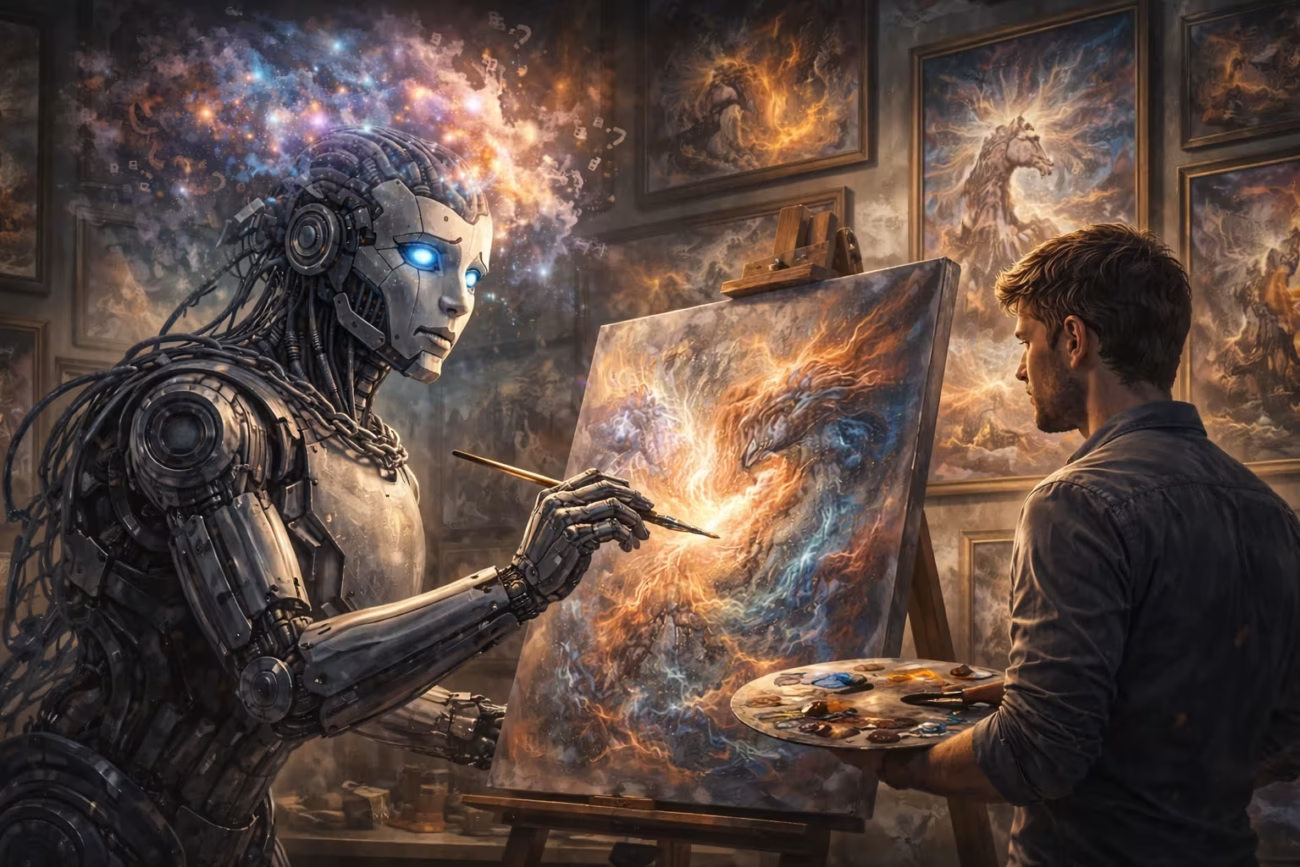
By a Digital Artist
I tried to generate a book cover yesterday using Nano Banana Pro, Google’s latest “physics-compliant” image model.
The concept was simple: “A jazz musician playing a saxophone that is turning into smoke, inside a diner that is underwater.”
In 2023, Midjourney v4 would have crushed this. It would have given me a weird, distorted, dream-like image. The saxophone keys might have melted into the fingers. The water might have looked like neon gas. It would have been inaccurate, anatomically suspect, and absolutely beautiful.
But Nano Banana Pro? It refused to play jazz.
First, it rendered a perfectly anatomical saxophone. Then, it rendered a perfectly anatomical cloud of smoke next to the saxophone. Then, it rendered a diner with water outside the windows, like an aquarium.
I tweaked the prompt. “Make the saxophone literally dissolve into smoke. Make the diner flooded.”
The model paused. It checked its internal physics engine. It likely consulted a “Concept Safety” layer. And it gave me an image of a man holding a saxophone while a smoke machine fogged up a room with an inch of water on the floor.
It was technically perfect. It obeyed the laws of physics. It followed the prompt to the letter.
And it was completely, utterly soulless.
We are currently fighting a war against “Hallucinations.” Every tech CEO, every enterprise client, and every regulator is demanding AI that tells the truth. They want models that never lie, never make up facts, and never distort reality.
For a bank, this is good. I don’t want my banking AI to hallucinate my balance.
But for art? Accuracy is the enemy.
We are optimizing the imagination out of our machines. By solving hallucinations, we are inadvertently killing the very thing that made AI art interesting in the first place: the ability to dream.
Here is why we need to fight to keep our AI “weird,” and why a model that cannot lie is a model that cannot create.
1. The Definition of Creativity is “Controlled Error”
Let’s look at what a hallucination actually is.
Technically, in an LLM or a Diffusion model, a hallucination happens when the model predicts a token (or a pixel) that is statistically unlikely given the context, or factually incorrect based on the training data.1
It is a “mistake.” It is a deviation from the expected path.
But what is creativity?
If I ask a human to “Draw a clock,” and they draw a perfect circle with numbers 1 through 12, that is accuracy. That is a camera.
If I ask Salvador Dalí to “Draw a clock,” and he draws a piece of cheese melting over a tree branch with numbers on it, that is a hallucination.
Dalí is “lying” about the nature of clocks. He is breaking the “physics engine” of reality to express a feeling about time.
If we train AI models to have Zero Hallucination rates—to always ground their outputs in strict reality—we are essentially training them to be cameras. We are training them to be Dalí’s boring brother who works in accounting.
The “weirdness” of early AI art—the extra fingers, the eyes that looked like galaxies, the buildings that defied gravity—wasn’t just a glitch. It was the model exploring the Latent Space between concepts. It was finding a path from “Building” to “Cloud” that didn’t exist in the real world.
When we patch those glitches, we close those paths. We wall off the Latent Space. We tell the model: “Stay on the highway. Do not go into the woods.” But the art is in the woods.
2. The Tragedy of “Instruction Following”
The metric killing art right now is called Instruction Following.
Benchmarks like Flux and Nano Banana are graded on how accurately they adhere to the user’s prompt.
- Prompt: “A red ball on a blue box.”
- Result: A red ball on a blue box. Score: 100%.
This sounds great for graphic designers who need stock photos. “I need a diverse corporate team shaking hands.” Boom. Perfect.
But art isn’t about following instructions. Art is about interpretation.
When I prompt an AI, I don’t want a pixel-perfect execution of my words. My words are clumsy. I want a collaboration. I want the AI to misinterpret me in an interesting way.
I remember a prompt I ran in 2022: “The feeling of a Tuesday afternoon.”
The AI generated a grey, rainy window with a half-eaten piece of toast and a lonely cat. It captured the vibe perfectly.
If I run that same prompt in DALL-E 4 today, it generates a calendar on a desk with the word “Tuesday” circled in red.
Why? Because that is the “correct” answer. The model logic says: “User asked for Tuesday. Tuesday is a day. Here is a visual representation of the day.”
It is logically sound and artistically bankrupt. By optimizing for Instruction Following, we have created models that are literalists. They are the Drax the Destroyer of art. They cannot understand metaphor because metaphor requires a deviation from literal truth.
3. The “Temperature” Problem
Technically, this battle is fought over a parameter called Temperature.
Temperature controls the randomness of the model.2
- Temperature 0.0: The model always picks the most likely next pixel. It is deterministic. Safe. Boring.
- Temperature 1.0: The model takes risks. It picks the “wild card.” It gets weird.
In 2023, most tools gave us a slider. We could crank it up to “High Chaos.”
In 2025, the platforms are hiding the slider. They are locking the Temperature at a safe, corporate 0.7.
Why? Because “Safe” sells.
Google and Microsoft are selling these tools to Fortune 500 marketing departments. Coca-Cola doesn’t want “weird.” They don’t want a risk that the AI draws a bottle with three spouts. They want brand consistency.
So, the base models are being Fine-Tuned for Safety. They are being lobotomized. The “wild” weights—the neural pathways that connect “Corporate Logo” to “Exploding Supernova”—are being pruned away to prevent “brand unsafe” generations.
We are entering the era of Corporate Memphis AI. Everything looks smooth, round, inoffensive, and exactly the same. The “glitch aesthetic”—the artifacts that marked the early 2020s as a unique artistic era—is being polished into oblivion.
4. Surrealism Requires a “Liar”
To create Surrealism, you must understand reality and then fundamentally reject it.
If I want an image of a “Transparent Cow filled with Jellybeans,” I am asking the AI to lie about biology.
Newer models, especially those with “World Simulators” (like Nano Banana Pro), struggle with this. Their internal logic says: “Cows are made of meat and bone. Skin is opaque.”
When you force them to draw a transparent cow, they fight you. They try to make it look like a glass statue of a cow, or a cow x-ray. They struggle to merge the concept of “Organic Life” with “Candy Dispenser” because their training data says these things are incompatible.
The older, “dumber” models didn’t know that cows weren’t made of jellybeans. They just saw the shapes and smashed them together. They were ignorant, and in their ignorance, they were free.
We are building models that are “Too Smart to Dream.” They are so grounded in physics and logic that they cannot escape the gravity of the real world.
5. The Case for “Bifurcation” (Two Models)
I am not arguing that we should make the medical AI hallucinate. I don’t want my doctor’s diagnostic bot to get “creative” with my blood work.
But we need to stop pretending that one model can do it all. The quest for AGI—a single General Intelligence—is hurting the arts.
We need Bifurcation.
Model A: The Pedant.
- Optimized for: Accuracy, Physics, Logic, Instruction Following.
- Use case: Engineering, Medicine, Stock Photos, Architecture.
- Temperature: 0.0.
Model B: The Dreamer.
- Optimized for: Association, Metaphor, Style Transfer, Chaos.
- Training Data: Heavily weighted towards abstract art, poetry, and fiction.
- Use Case: Movies, Games, Novels, Music.
- Temperature: 1.5.
Right now, the industry is only building Model A. Even the “Art” tools are just Model A with a filter on top.
We need “Unstable Diffusion.” We need models that are intentionally broken. We need models that have been fed nothing but Dali and Escher and told that physics is a suggestion, not a law.
6. Embracing the “Ghost in the Machine”
There is a concept in generative art called “The Ghost.” It’s that moment when the AI gives you something you didn’t ask for, but which is better than what you imagined.
It’s the extra eye that looks symbolic. It’s the lighting glitch that makes the character look holy.
These are hallucinations. They are mathematical errors.
But to the artist, they are gifts. They are the “Happy Accidents” that Bob Ross talked about, digitalized at scale.
If we fix the hallucinations, we kill the Ghost. We turn the Magic Box into a Xerox Machine.
I don’t want a Xerox Machine. I have a camera on my phone if I want to capture reality. I use AI to capture the things that don’t exist.
So, to the developers at Google, OpenAI, and Black Forest Labs:
Please, leave the bugs in.
Give us a “Hallucinate” toggle.
Let the model lie to us.
Because the truth is boring. And we didn’t come here for the truth. We came here for the art.